PVC holds the largest share of the global plastic pipe market at over 53 percent of total revenue, according to Grand View Research. That dominant market position translates into an enormous production scrap and end-of-life volume. PVC pipe manufacturers generate startup scrap, dimensional rejects, and trim waste every shift. Recyclers and contractors handle end-of-life PVC pipe from water systems, conduit networks, and agricultural installations. And the programs to recycle that material are growing fast.
Plastics News reported in July 2025 that PVC pipe recycling activity in the United States is expanding, with new facilities coming online in Texas and Ohio specifically to handle large-diameter rigid PVC pipe that exceeds the capacity of standard processing equipment. The Revinylize Recycling Collaborative, PEPA, and Return Polymers are all actively building out the collection and processing infrastructure that the market needs. What makes all of that possible at the processing end is the right equipment configuration. For PVC pipe, that configuration has three stages.
PVC’s share of the global plastic pipe market by revenue in 2025, the single largest material segment
Projected growth rate for the global PVC pipes market from 2026 through 2033
U.S. PVC pipe recycling programs actively expanding with new facilities and collection programs in 2025
Why PVC Pipe Specifically Needs a Three-Stage Process
The reason PVC pipe recycling requires three processing stages comes down to the downstream application. PVC pipe extrusion uses powdered PVC compound as its feedstock, typically in a particle size range of roughly 100 to 500 microns. You cannot re-extrude granules directly into new PVC pipe the way you can blend HDPE regrind back into an HDPE extruder. The material must be in powder form.
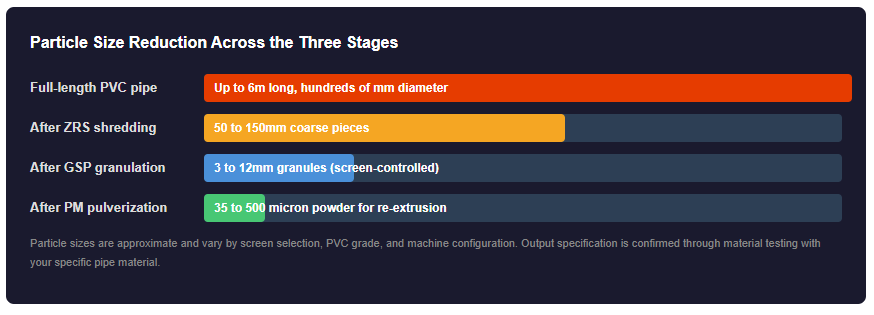
A granulator produces particles in the 3 to 15mm range. A pulverizer produces powder in the 35 to 500 micron range. Getting from a full-length PVC pipe to feedstock-grade PVC powder requires all three steps: a shredder to handle the pipe at full size, a granulator to bring it down to granule grade, and a pulverizer to produce the powder that goes back into pipe production.
The Three-Stage PVC Pipe-to-Powder Processing Line
ZRS Pipe Shredder
Horizontal feed trough with hydraulic ram. Accepts full-length PVC pipe without pre-cutting.
Output: Coarse shredded pieces, 50-150mm range
GSP Pipe Granulator
Pipe and profile granulator finishes shredded material to granule size.
Output: Granules, 3-12mm (screen-controlled)
PM Plastics Pulverizer
Disc-on-disc grinding with classifier produces fine PVC powder.
Output: PVC powder, 35-500 microns for new pipe extrusion
Stage One: The ZRS Pipe Profile Shredder
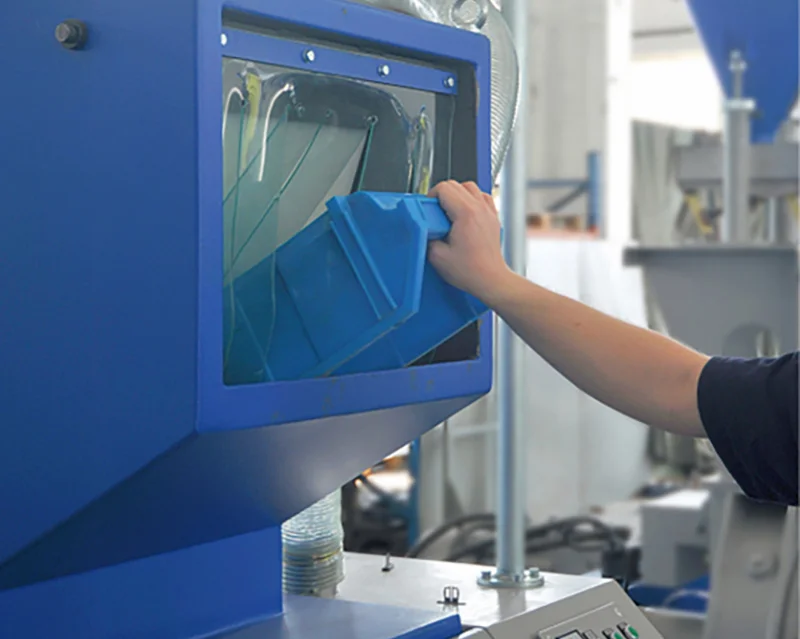
The ZRS handles the most difficult part of the process: the full-length pipe as it arrives. Its horizontal feed trough accepts PVC pipe of varying diameters and lengths. The hydraulic ram drives the pipe through the cutting zone at a controlled, consistent rate, which prevents overload when the rotor encounters thicker wall sections and ensures the machine runs without intervention throughout the shredding pass.
For PVC specifically, the dust extraction system connected to the ZRS is not optional. PVC shredding generates chlorine-containing dust that requires proper ventilation and collection for both operator safety and regulatory compliance. ZERMA America can advise on the correct extraction specification for your facility volume and local requirements.
Stage Two: The GSP Pipe and Profile Granulator
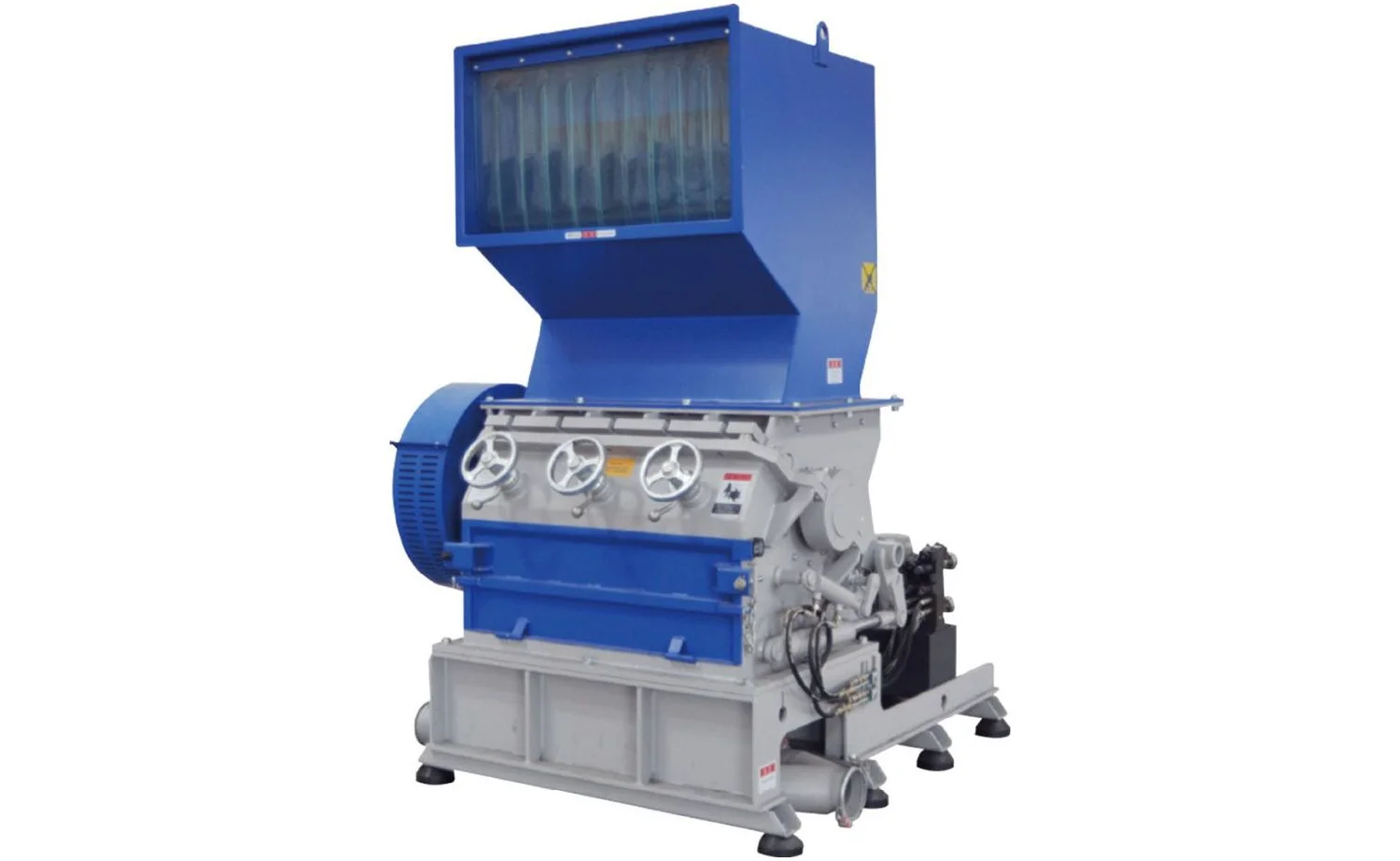
Once the ZRS has reduced the pipe to coarse shredded pieces, the material moves to the GSP Pipe and Profile Granulator. The GSP is specifically designed for this application. Its rotor and screen geometry are optimized for the angular, irregular pieces that come from a pipe shredding operation, and its screen selection controls the output granule size to the specification needed by the downstream pulverizer.
Running the material through a dedicated pipe granulator at this stage, rather than a general-purpose unit, produces more consistent granule size distribution and fewer fines, which improves pulverizer efficiency and output powder quality in the final stage.
Stage Three: The PM Plastics Pulverizer
The PM Plastics Pulverizer uses a disc-on-disc grinding mechanism with a built-in classifier. Granules fed into the PM are ground between a stationary disc and a rotating disc at controlled speed. The gap between the discs determines the final particle size. A classifier system separates on-specification powder from oversized particles, which recirculate through the grinding zone until they meet the target specification.
Temperature control is critical in this stage. PVC powder can sinter or agglomerate if the grinding zone gets too warm. The PM’s design manages this through machine geometry and operating parameters. This is one reason why feeding the pulverizer with proper-sized granules from the GSP matters: oversized input to the pulverizer creates excessive grinding load and heat generation that degrades both output quality and machine performance.
Where the Powder Goes: Closing the Loop
| Powder Output Application | Specification Notes | Market Context |
|---|---|---|
| New PVC pipe extrusion (same-grade) | Requires consistent particle size and clean material; post-industrial scrap from same production site is highest-quality feedstock | Direct in-house loop reduces virgin compound consumption. Highest economic value of any output pathway. |
| New PVC pipe (non-pressure rated) | Post-consumer or mixed-source PVC powder typically goes to drainage, conduit, or non-pressure applications | Established U.S. market through Revinylize and similar programs. Return Polymers blending technologies support this pathway. |
| Other PVC products (siding, fencing, profiles) | PVC powder is fungible across many extrusion applications with compatible compound specifications | Broader end-market optionality reduces dependence on any single outlet. |
Watch Pipe and Profile Equipment in Action
See the ZRS pipe shredder and GSP granulator in real production conditions. The P-Series overview videos below show the same horizontal trough and hydraulic ram design used in the ZERMA ZRS.
- P-Series / ZRS Pipe Shredder Overview
See the horizontal trough and hydraulic ram design in the official pipe profile shredder overview. - Pipe Shredder in Production Operation
Watch the pipe profile shredder processing pipe material with hydraulic ram feed control in real conditions. - Full ZERMA YouTube Channel
All ZERMA equipment demonstrations including ZRS, ZCS, GSP, and PM Plastics Pulverizer systems. - Send Us Your Pipe Material for Testing
Ship your pipe or profile material to our Fort Myers facility. We run it live and send you the video results.