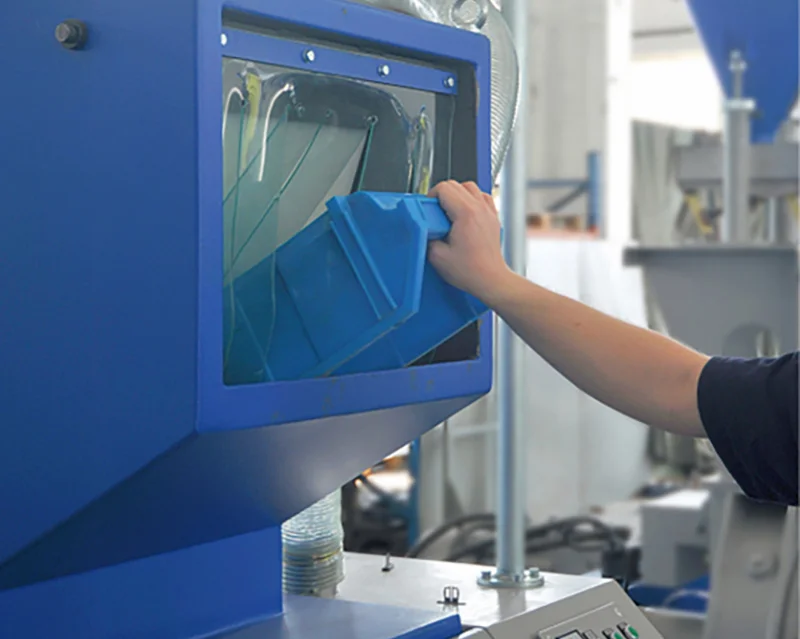
There is a version of buying equipment that goes badly in a very specific way. The purchase price comes in under budget, everyone signs off, and then the machine spends the next six years quietly costing more than the expensive one would have. Knife changes take too long. The regrind has too many fines to blend at the ratio you planned. Something wears out that was never meant to be replaced.
Economizing on a granulator is entirely reasonable. Economizing on the wrong parts of a granulator is what turns a good decision into an expensive one. It is worth being precise about which is which.
What actually drives the cost of owning a granulator
The sticker price is a single payment. Everything else is recurring, and the recurring items are where the money really lives.
Knife life and changeover time. Knives are consumable, and that is fine. What is not fine is a design that makes changing them slow. A machine that takes an extra hour per changeover, several times a month, has quietly bought back its own discount in lost production within a couple of years.
Regrind quality. This one is easy to overlook and expensive to get wrong. If a machine produces regrind with a high percentage of fines, you cannot blend it back at the ratio your process model assumed. You either buy more virgin resin than planned or you accept quality problems. Either way, you are paying for the machine’s shortcomings every single shift.
Right-sizing. An undersized granulator does not merely run slower. It tears material instead of cutting it cleanly, which accelerates wear and degrades output. Buying too small is the most common false economy in this category.
Where the GSE does not compromise
The GSE Series is built around the parts that determine long-term cost, not the parts that pad a brochure.
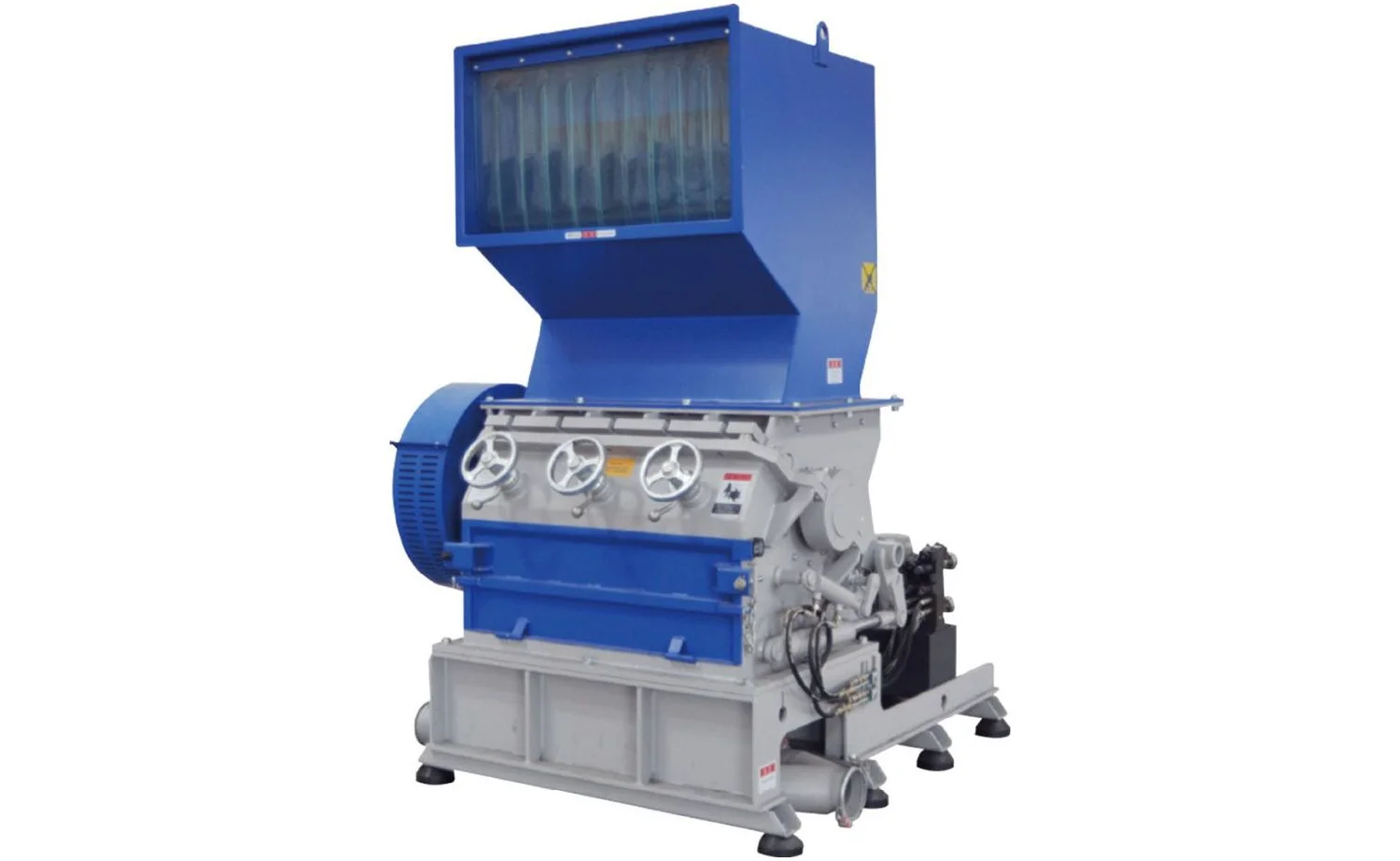
Every machine in the series uses a completely welded cutting chamber and V-cut rotor technology, the same cutting geometry found across the ZERMA granulator range. That V-cut is what produces clean, uniform granules with a low percentage of fines, which is the specification that protects your blend ratio and therefore your resin budget.
Maintenance is where the design pays you back most directly. The rotor and stator knives are pre-set outside the machine on a supplied fixture before installation, so changeovers do not involve reaching into a cutting chamber to make fine adjustments. That single design choice removes the recurring time cost that quietly undermines cheaper machines.
What you are actually giving up
Being honest about this matters. Choosing the GSE means forgoing the soundproof enclosure of the GSC family. If noise is a live problem on your floor, that is not a feature to economize on, and you should look at the GSC instead.
It also means forgoing the heavy industrial construction of the GSH. If your material is thick-walled, abrasive, contaminated, or running around the clock, the GSE is the wrong tool, and the money you save at purchase will be spent on wear and downtime instead.
What you are not giving up is regrind quality or serviceability. That is the distinction that makes the GSE a sound economy rather than a false one.
The three models
| GSE 300 | Built for small, thin-walled, or hollow parts. The natural first serious granulator for a shop outgrowing a small press-side grinder. |
| GSE 500 | Takes on bigger hollow parts and more material. The middle choice when volume has outgrown a small machine. |
| GSE 700 | Grinds voluminous material and works as a central granulator. A redesigned base makes it very sturdy while keeping the cutting chamber easy to reach. |
Rotor diameters run from 300 mm to 700 mm in widths from 300 mm to 1400 mm. Sizing follows one rule above all others: start with your largest and most voluminous part, because that sets the floor. Then check it against your throughput. Undersizing to save money is the mistake this article exists to prevent.
Prove it with your own material
The whole argument above collapses into one practical test. Ship us a box of your actual scrap, tell us your volumes and what the regrind needs to become, and we will run it at our Fort Myers facility, film the test, and send you the footage with a confidential technical analysis. If the economical machine really is the right answer for you, you will see the proof. If it is not, you will find that out for the price of shipping a box rather than the price of a machine.
Our YouTube channel also carries demonstrations across the ZERMA range if you want to see the machines running first.
The part of ownership cost you can control
Knives and screens wear on every granulator ever built. What you can control is how long you wait for replacements. They are stocked at Virtus Equipment Direct, our online parts store, so a worn knife is an order rather than a quote request and a week of downtime. Our service team handles installation, commissioning, operator training, and maintenance scheduling, and our service line is bilingual in Spanish.
Frequently asked questions
Is an economical granulator lower quality?
Not in the ways that matter for output. The GSE uses the same V-cut rotor and welded cutting chamber as the rest of the ZERMA range, so regrind quality is not what you are trading away. You are forgoing features a given job may not need, such as a soundproof enclosure or heavy industrial construction.
What is the most common mistake buyers make here?
Undersizing. A granulator that is too small tears material rather than cutting it, which produces poor regrind and accelerates wear. The money saved at purchase gets spent several times over in resin and maintenance. Size to your largest part first, then confirm against throughput.
Can one GSE work both beside the press and as a central granulator?
The family spans those roles but the model matters. The GSE 300 leans toward press-side and medium volume, while the GSE 700 is built to serve as a central granulator. If you expect the role to change as you grow, say so before you buy so it gets sized once rather than twice.
When should I step up to the GSH heavy duty range?
When the work is genuinely industrial: thick-walled parts in one step, abrasive or contaminated material, or nonstop high-volume duty. For everyday medium-volume recycling, spending up to the GSH is money that will not come back.
Terms worth knowing
Total cost of ownership. Purchase price plus everything that recurs afterward: knives, screens, energy, changeover labor, downtime, and the resin cost of poor regrind. It is the only number that actually matters when comparing machines.
V-cut rotor. The rotor knife geometry that shears material progressively, producing uniform granules with a low percentage of fines.
Fines. Dust-sized particles in the regrind. High fines content narrows how much regrind you can safely blend back with virgin resin, which turns a machine shortcoming into a recurring material cost.
Blade gap. The clearance between rotor and bed knives. It governs cut quality and particle size, and it is the first thing to check when regrind quality drifts.
Central granulator. A larger machine serving multiple presses or a whole plant from one location, which is the role the GSE 700 is built for.
Related ZERMA machines
- GSL slow speed granulators for press-side sprues and runners
- GSC soundproofed granulators when noise is the constraint you cannot economize on
- GSH heavy duty granulators for thick-walled, abrasive, or nonstop industrial duty
- ZSS general purpose shredder when scrap is too bulky to granulate directly