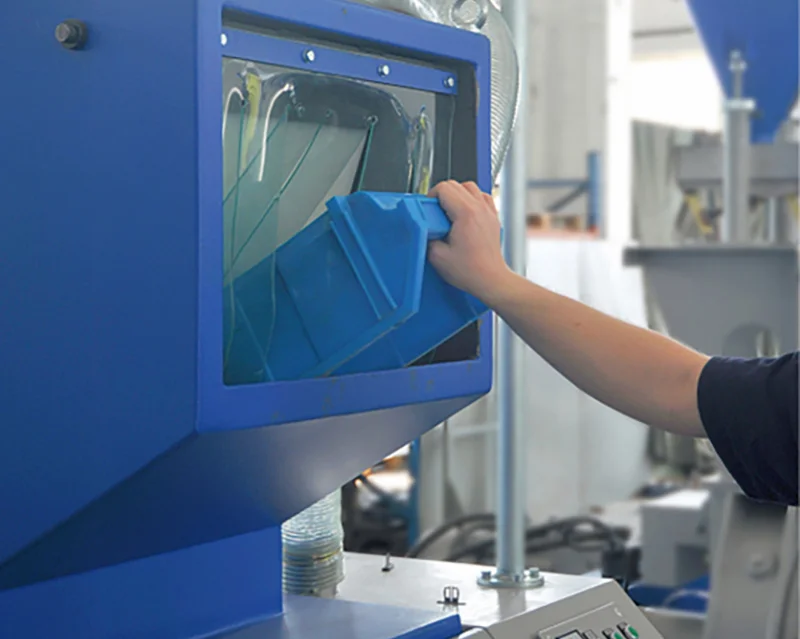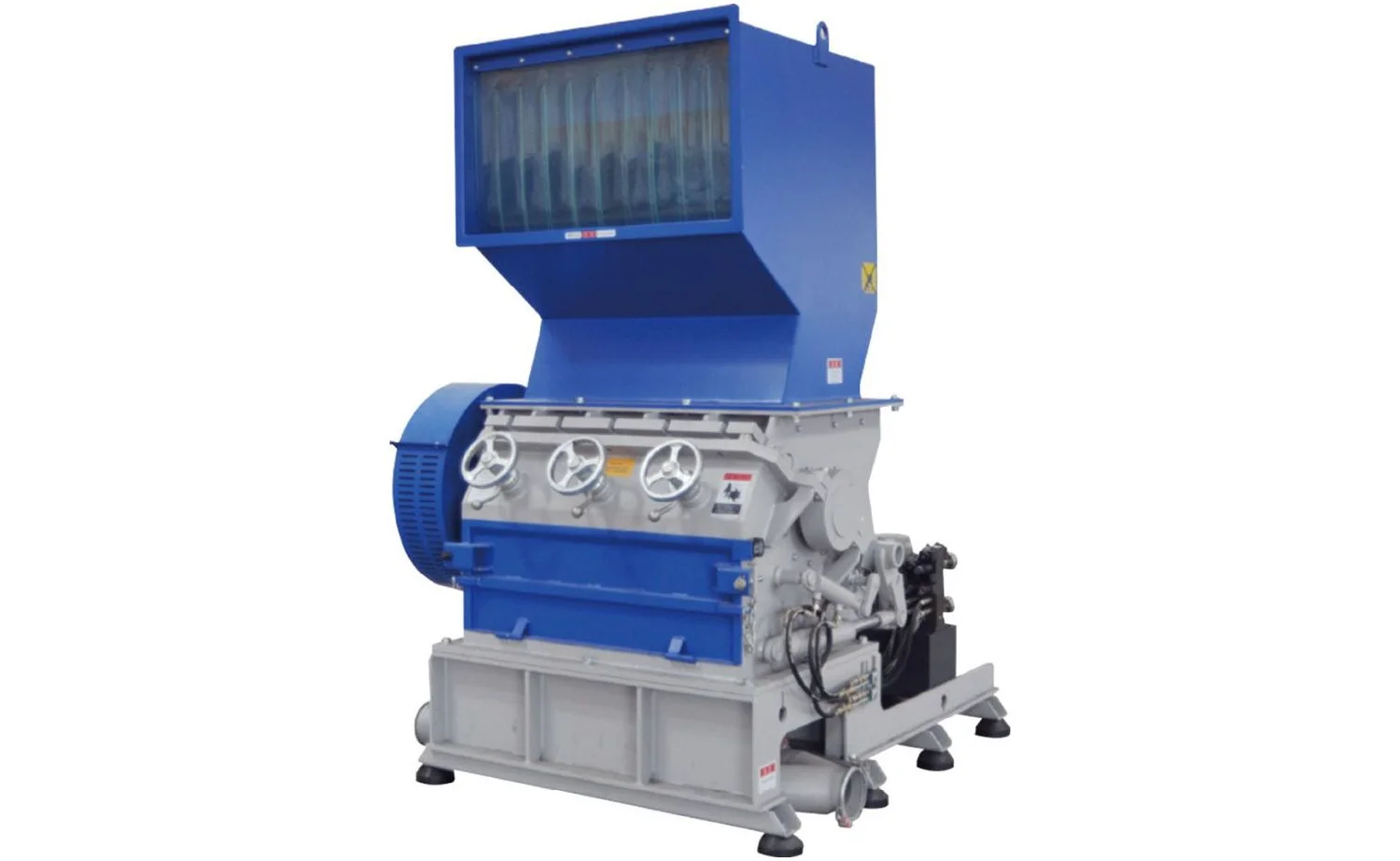
When a granulator cannot handle the material, the instinct is to buy a larger granulator. It is the wrong instinct, and understanding why is the fastest route to buying the right machine.
A granulator is a gravity-fed device. It assumes material will fall into the cutting circle under its own weight and stay there. Every design decision follows from that assumption. Make the machine bigger and you have simply built a larger device that still assumes gravity will do the feeding, which does nothing for a bale, a purge block, or a length of pipe that has no intention of falling anywhere useful.
The thing that actually solves the problem is not size. It is a ram.
Force, not speed
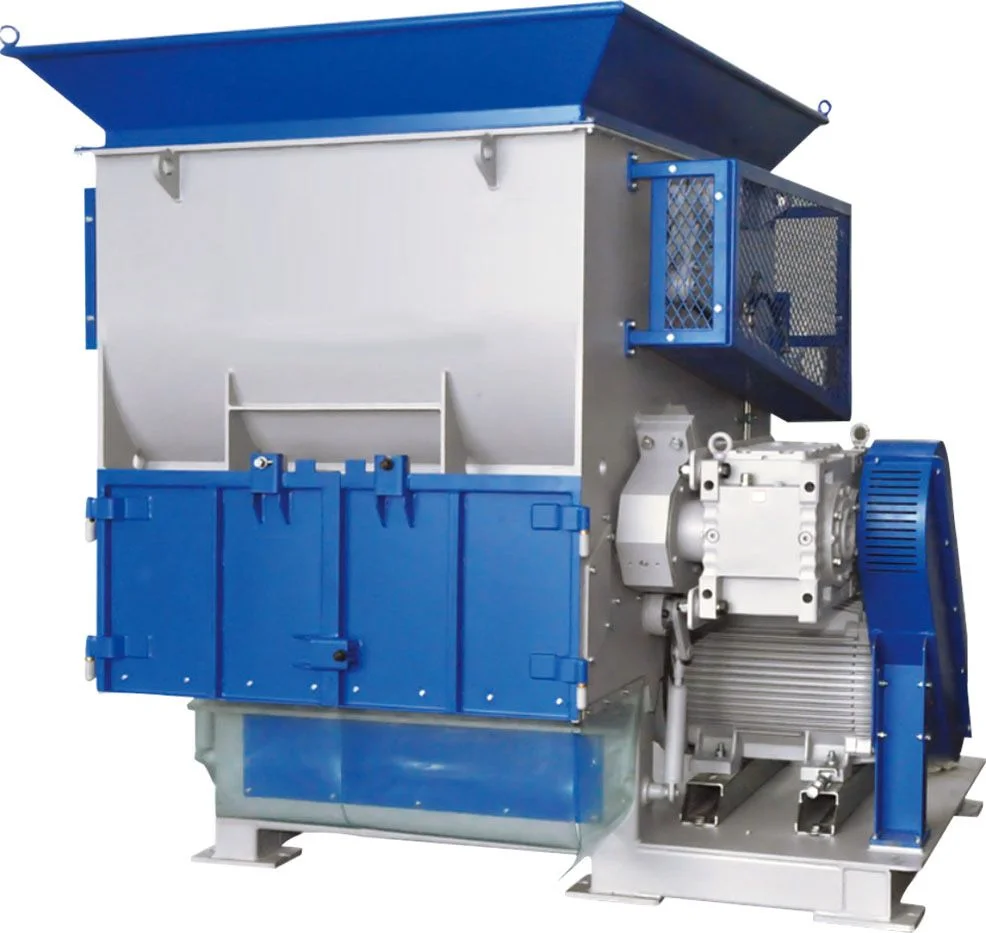
A shredder inverts the granulator’s whole operating principle. Where a granulator uses high speed and moderate torque to slice, a shredder uses low speed and very high torque to overpower. The rotor turns slowly against a fixed counter knife, tearing material apart rather than shearing it cleanly, and a screen beneath the chamber holds anything oversized in the cutting zone until it has been reduced enough to pass.
That slow, forceful action is what makes bulky and dense material tractable. But torque alone is not sufficient. The rotor still has to make contact with the material, and bulky scrap does not present itself obligingly. It bridges over the opening. It sits on top. It wedges. Gravity is simply not a reliable delivery mechanism at this scale, which is why the ram exists and why it deserves more attention than it usually gets.
The ram is where shredders are won or lost
Most shredder rams slide. They run along internal guide rails, pushing material forward and retracting to take another bite. It works, and it also introduces two failure modes that anyone who has run such a machine will recognise: material works its way into the rails and causes blocking, and the rails themselves wear, which progressively degrades the feed.
The ZSS uses a two-speed hydraulic swing ram instead. It feeds with a swing action rather than sliding along rails, which eliminates the rail wear and the blocking that comes with it, because there are no rails for material to get into. Two speeds matter as well: high pressure on the forward stroke where you need the force, and a fast backstroke so the machine is not spending its cycle waiting to take the next bite.
A related design decision is easy to overlook until you need to service the machine. The hydraulic power pack sits inside the shredder housing, which saves floor space and protects it from damage, while remaining accessible for maintenance. A hydraulic system bolted to the outside of a machine on a busy floor is a hydraulic system that eventually gets hit by something.
Specification
| Rotor | 457 mm E-type rotor, widths from 850 mm to 2000 mm |
| Feed | Two-speed hydraulic swing ram, no internal guide rails to wear or block |
| Drive | Oversized gearbox delivering low speed and high torque |
| Bearings | Outboard, sitting outside the cutting chamber away from material and contamination |
| Output sizing | Hydraulically operated screen cradle, so changing output size is quick rather than a wrestling match |
| Wear options | Rotor cooling, hard facing, and additional wear packages for abrasive material |
What it will take
The ZSS is a genuinely broad machine, which is what earns it the general purpose label. It handles plastic lumps and purge, pipes and profiles, film, woven bags and bales, rigid and flexible plastics, cables, paper and wood, and electronic waste.
It also handles textiles, which surprises people. Fabric offcuts and material like denim jeans shred perfectly well as a first-stage size reduction, though the right screen and knife configuration depend heavily on your volume and on what happens to the material afterwards. That is a conversation worth having rather than a specification to assume.
What the ZSS is not the best answer for: very large diameter pipe belongs on a ZRS, whole tires belong on a ZXS-T, and the very toughest around-the-clock industrial duty belongs on a ZXS. Those are specialists, and specialists exist because the general purpose machine has limits.
The shredder is usually stage one, not the whole answer
A shredder produces coarse output, not regrind. If your material needs to come back as usable feedstock, the shredded output feeds a granulator, and that two-stage architecture is standard for a reason: each machine does the job it was built for, and neither is asked to do the other’s. The screen in the shredder is what sets how coarse that intermediate material is.
Send us the difficult material
Shredder performance depends heavily on the specific shape, density, and feeding behaviour of your material, which is exactly the sort of thing that resists prediction on paper. Ship us a sample. Tell us your volume and what the output needs to become. We run it at our Fort Myers facility, film the test, and send you the footage with a confidential technical analysis.
Our YouTube channel carries demonstrations across the ZERMA range, including single-shaft shredders working on a variety of materials.
Knives and screens are consumed, not damaged
On a shredder, knives and screens are high-wear items by design. Replacements are stocked at Virtus Equipment Direct, our online parts store, so a worn part is an order rather than a quote and a week of lost production. Our service team handles installation, commissioning, operator training, and maintenance scheduling, and our service line is bilingual in Spanish.
Frequently asked questions
Why can I not just buy a bigger granulator instead of a shredder?
Because a granulator is gravity-fed, and scaling it up does not change that. Bulky material bridges, sits on top of the rotor, and refuses to fall into the cutting circle. A shredder solves the problem with a hydraulic ram that forces material into the rotor, plus low-speed high-torque cutting. It is a different operating principle, not a bigger version of the same one.
What is the advantage of a swing ram over a sliding ram?
A sliding ram runs on internal guide rails, which material can get into (causing blocking) and which wear over time (degrading the feed). The ZSS swing ram feeds with a pivoting action and has no such rails, which removes both failure modes.
Can a ZSS shred textiles such as denim?
Yes. A single-shaft shredder handles fabric and textiles as a first-stage size reduction. The right screen and knife setup depends on your volume and on what the material becomes next, which a material test settles quickly.
Does the shredder produce usable regrind on its own?
No, and it is not meant to. It produces coarse output sized by the screen. If you need regrind, that output feeds a granulator as a second stage. Each machine does the job it was designed for.
Terms worth knowing
Hydraulic ram. The powered pusher that forces bulky material into the cutting chamber. It is the component that makes a shredder a shredder, because bulky scrap will not feed itself.
Swing ram. A ram that feeds with a pivoting action rather than sliding along internal guide rails, which removes the rail wear and material blocking that sliding designs are prone to.
Counter knife. The stationary knife the rotor works against. In a shredder it is what the material is torn apart on.
Screen cradle. The assembly holding the screen beneath the cutting chamber. Hydraulic operation is what turns an output size change from an ordeal into a routine task.
Two-stage size reduction. Shredding bulky material first, then granulating the output into uniform regrind. The standard architecture whenever incoming scrap is too large to granulate directly.
Related ZERMA machines
- ZIS big volume shredder for bulky containers like IBCs, wheelie bins, and drums
- ZXS heavy duty shredder for the toughest, highest-throughput work
- ZRS pipe and profile shredder for large diameter pipe
- GSH heavy duty granulators as the second stage that turns shredded output into regrind