Ask why a granulator cannot handle purge and most people will say it is too big. That is true but incomplete, and the incompleteness matters, because if size were the whole problem then a larger granulator would solve it. It does not.
Purge is a genuinely different material from the scrap a granulator was designed around, and it is worth being precise about how.
What purge actually is
A molded part is a designed object. It has a known wall thickness, a predictable geometry, and it arrives at the granulator looking the same way every time. A granulator’s cutting chamber, screen, and knife arrangement are all built around that consistency.
Purge is the opposite of a designed object. It is a solidified melt: material that came out of the machine as a liquid and hardened into whatever shape it happened to land in. It has no consistent geometry, no predictable size, and no uniform wall thickness, because it has no walls. It is dense the whole way through, which means a knife entering it is cutting solid mass rather than shearing a thin section.
That density is the crux. A granulator’s rotor knives are designed to slice sections, not to chew through solid blocks of resin. Feed a purge cake into a machine built for runners and you are not asking it to work harder. You are asking it to do something it was never designed to do, and the results are predictable: stalling, overload, and knife damage.
Force applied slowly, on a small scale
The answer to dense material is low speed and high torque, which is the operating principle of a shredder. But the shredders built for that job are typically large industrial machines, and a molding shop generating a few purge cakes per changeover does not need a large industrial machine. It needs the shredder principle applied at a sensible scale.
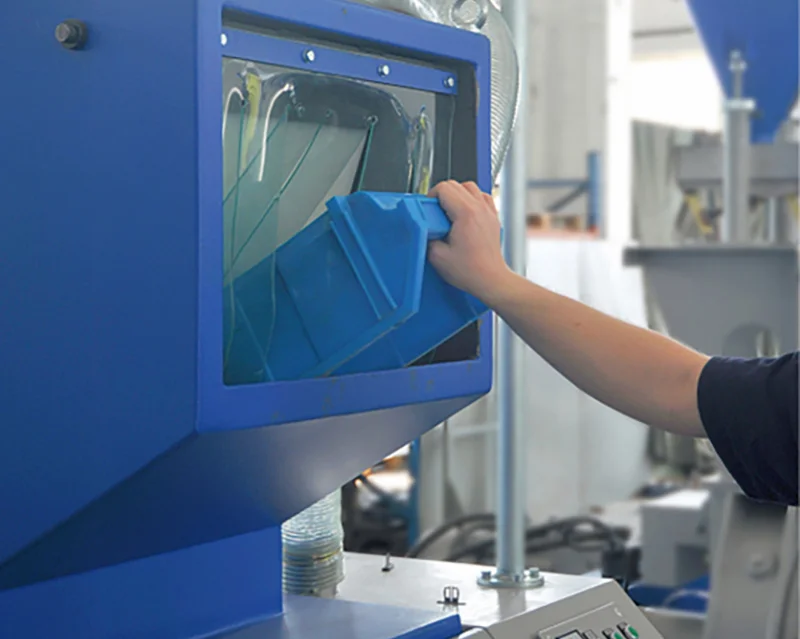
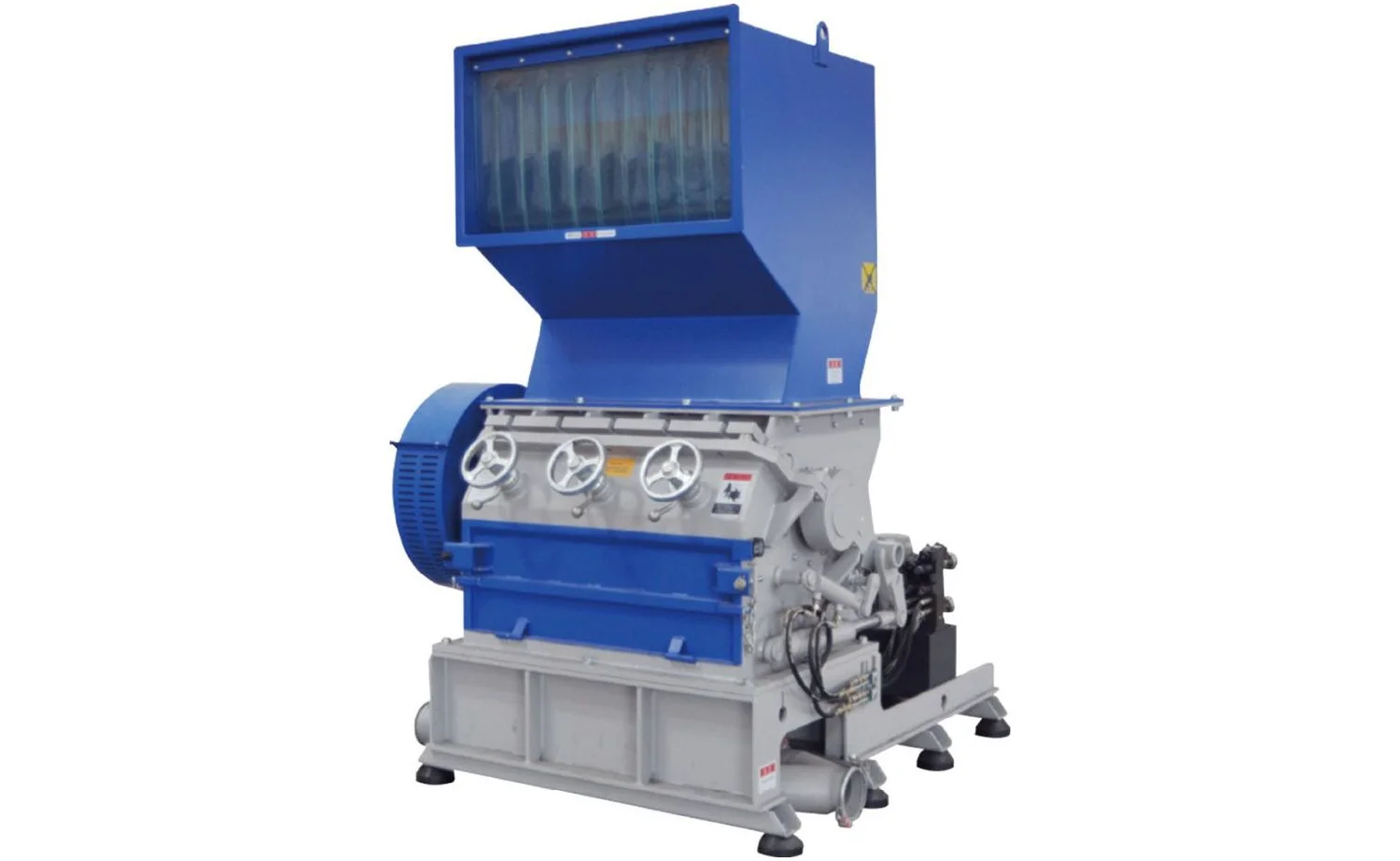
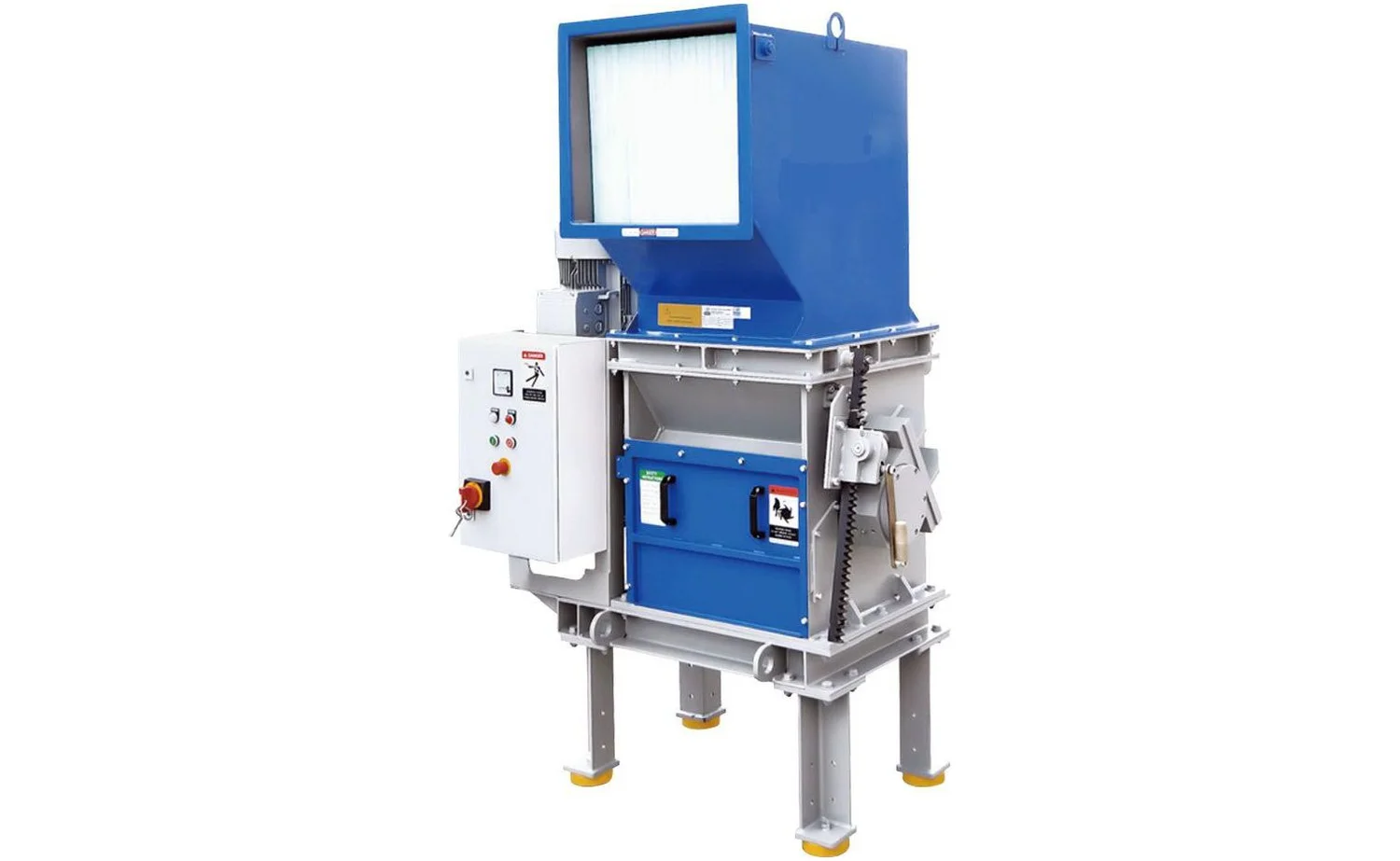
That is what the ZBS is. It runs a 310 mm flat E-type rotor, in a choice of 600 mm or 850 mm widths, using the same proven ZERMA knife and knife holder design found across the shredder range. It is driven by an oversized gearmotor and runs on outboard bearings, so the mechanical foundation is the same quality as the big machines. It is simply right-sized for the job.
The simplicity is the point, not a compromise
Here is where the ZBS makes a deliberate engineering choice that is easy to mistake for a cost saving.
Most shredders need a hydraulic ram, because most shredders are dealing with bulky material that will not feed itself. But purge is dense, not bulky. It does not bridge or float or bounce. It falls. So the ZBS uses a tangential infeed and dispenses with the hydraulic feeding system entirely.
That removes an entire subsystem: no hydraulic power pack, no hoses, no fluid, no ram maintenance, and no hydraulics to fail. Combined with plug-and-play controls, it produces a machine that can be installed and run without commissioning a complicated piece of equipment to grind what is, after all, just purge.
The low rotor speed of 60 rpm has a second benefit worth mentioning. It makes the machine quiet enough to shred lumps at a relatively low noise level, which matters when the machine lives in an occupied workshop rather than a separate room.
Specification
| Rotor | 310 mm flat E-type rotor, in 600 mm or 850 mm widths, with machined pockets that hold and secure the knives |
| Speed | 60 rpm, which delivers torque and keeps the noise down |
| Feed | Tangential infeed, with no hydraulic feeding system required |
| Knives | Concave ground square knives that can be rotated to a fresh edge when one side wears, with optional hard facing for abrasive material |
| Handling | Manual or conveyor fed, discharging by conveyor or into a dropbox |
Two things to do with the output
Once purge is shredded, you have a decision. You can reduce it purely for volume, which cuts disposal cost and makes the material far easier to handle and store. Or you can treat the shredding as stage one and run the output through a granulator, which turns material you already paid for back into usable regrind.
The second path is the one that recovers value rather than merely reducing cost, and for most molding operations it is the reason to buy the machine at all.
There is a quieter use case as well, and it comes up more than you might expect: the ZBS can destroy sensitive products or process small batches of low-volume material, keeping them from contaminating the main product line.
Send us a cake
Purge varies enormously in hardness and size between resins and processes, which makes it a poor candidate for guessing. Ship us a sample of your actual purge, lumps, or head waste. Tell us your volume and whether you intend to reduce it or granulate it afterwards. We run it at our Fort Myers facility, film the test, and send you the footage with a confidential technical analysis.
Our YouTube channel includes demonstrations of ZERMA equipment processing purge material.
Keeping it running
The knives are reversible, which stretches their life, but they are still consumables and so are the screens. Replacements are stocked at Virtus Equipment Direct, our online parts store. Our service team handles installation, commissioning, and operator training, and our service line is bilingual in Spanish.
Frequently asked questions
Why can a granulator not handle purge, even a large one?
Because the problem is density, not size. Purge is a solidified melt, dense all the way through, with no walls or sections to shear. Granulator knives are designed to slice sections, not to chew solid blocks of resin. A larger granulator is still a granulator, and it will stall, overload, and damage knives just the same.
Does the ZBS really not need a hydraulic system?
Correct, and this is deliberate rather than a saving. Hydraulic rams exist to force bulky material that will not feed itself. Purge is dense, not bulky, so it feeds tangentially under its own weight. Removing the hydraulic system removes an entire category of maintenance and failure.
Can I turn shredded purge back into usable material?
Yes, and that is usually the point. Shred as stage one, then granulate the output into regrind that can go back into production. Alternatively, shred purely to reduce volume and disposal cost.
Is it quiet enough for a workshop?
The 60 rpm rotor speed and compact design allow lumps to be shredded at a relatively low noise level, which is what makes it practical to keep the machine near where the purge is actually generated.
Terms worth knowing
Purge. Material discharged during a colour or resin changeover, which solidifies into a dense cake with no designed geometry. Its density, not its size, is what defeats a granulator.
Tangential infeed. A feed geometry where gravity and the rotor do the work, which is sufficient for dense material and removes the need for a hydraulic ram entirely.
Reversible knives. Concave ground square knives that can be rotated to a fresh cutting edge when one side wears, which extends knife life and lowers running cost.
Plug-and-play controls. Controls simple enough that the machine can be installed and run without a complex commissioning process.
Volume reduction. Shredding purely to make material cheaper to store and dispose of, as distinct from shredding as the first stage of recovering it into regrind.
Related ZERMA machines
- ZSS general purpose shredder for larger and more varied scrap than purge alone
- ZCS shredder granulator combination to shred and granulate purge in one closed machine
- GSE economical granulators to turn shredded purge into regrind
- GSH heavy duty granulators for thick-walled second-stage work