Every throughput figure you have ever read on a shredder spec sheet carries an unstated assumption: that the machine is being fed one material, consistently, in a predictable form. It is a reasonable way to publish a number. It is also a description of almost no working plant.
What actually arrives at the hopper over the course of a shift is a mix. Sheet, then chunks. A run of rejected parts, then a batch of offcuts that are thinner and floppier than anything before them. A machine that posts an impressive number on uniform feedstock and then stalls, bridges, or feeds erratically on the real thing has not solved your problem. It has just moved the problem to the operator, who now spends the day nursing it.
Feed reliability under variability is the specification nobody publishes, and for a lot of recyclers it is the one that governs uptime.
Why mixed feedstock breaks feeding
Different materials fail to feed in different ways, which is precisely what makes a mixed stream so awkward.
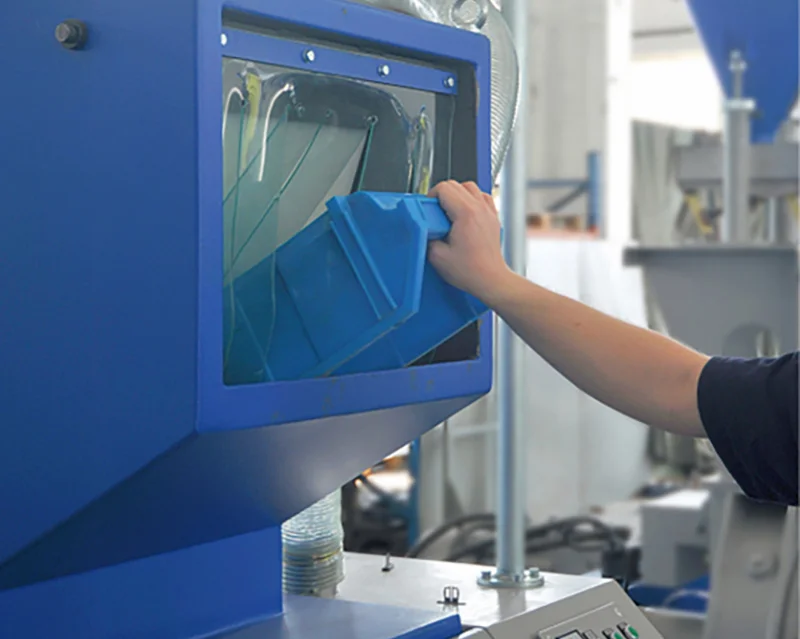
Dense chunks want to drop straight down, and they will sit in the bottom of a chamber quite happily. Flat sheet wants to lie across the opening and bridge, holding everything above it in suspension. Thin, floppy material wants to fold rather than be pushed, so a ram that works beautifully on rigid parts can simply crumple it. Bulky hollow items want to bounce.
A feed system optimised for any one of these behaviours will be mediocre at the others. What you need is a feeding geometry that is tolerant, one that keeps material moving toward the rotor across a range of shapes and stiffnesses rather than being tuned to a single ideal.
The angled ram
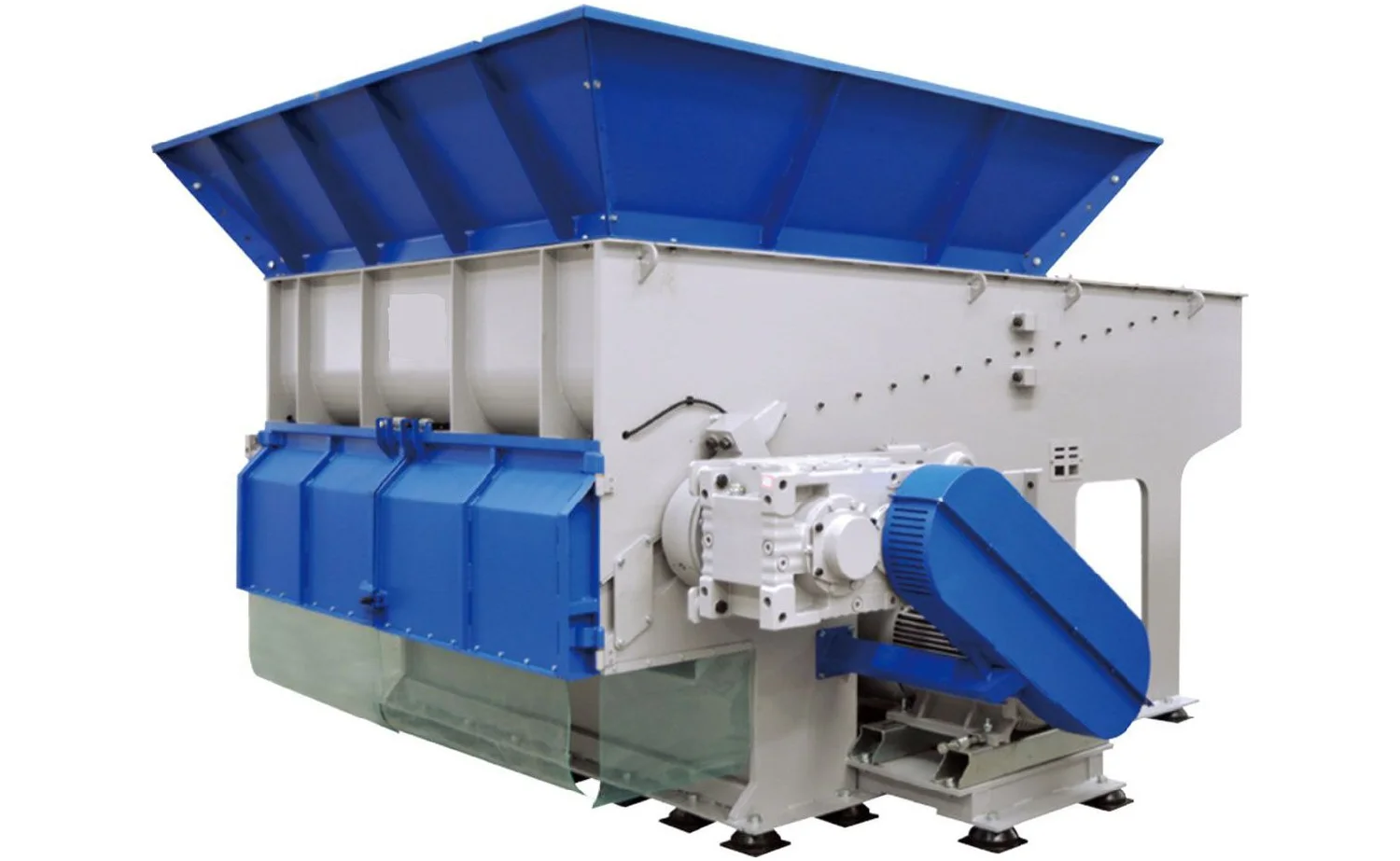
The defining feature of the ZHS is that its hydraulic ram approaches the rotor at an angle rather than pushing straight in. That angle is what makes the machine suitable for such a wide range of material shapes and sizes, because it guides varied material into the cutting zone consistently rather than relying on the material to present itself correctly.
Paired with a large feeding hopper and a low-speed, high-torque drive, the result is a shredder that keeps working steadily whether the next thing through the door is flat, chunky, thick-walled, or awkward. That is a quieter virtue than a headline throughput number, and on a mixed-stream floor it is worth considerably more.
Specification
| Rotor | 600 mm E-type rotor with the ZERMA knife holder fixing system, in widths from 1500 mm to 2600 mm |
| Feed | Angled hydraulic ram with a large feeding hopper |
| Drive | Low-speed, high-torque design in robust welded steel construction |
| Output sizing | The screen sets the final material size and is easily changed, so one machine can serve different downstream requirements |
| Tailoring | Different drive powers, knife configurations, and discharge options, so the machine fits your line rather than the reverse |
Where it fits
The ZHS is aimed squarely at operations that do not have the luxury of a single clean material stream. Post-industrial plastic recyclers dealing with offcuts, rejects, and production scrap in assorted shapes. General waste operations handling plastics, wood, paper, and mixed streams without wanting a separate machine for each. And processors building a line, since the ZHS integrates readily with conveyors, granulators, and other equipment rather than standing alone as an island.
It is not the specialist answer for every job, and it does not pretend to be. Large diameter pipe belongs on a ZRS. Whole tires belong on a ZXS-T. Very large containers are the ZIS‘s territory, and the very toughest around-the-clock industrial duty belongs on the ZXS. The ZHS earns its place as the dependable daily machine for everything in between, which for many plants is most of what arrives.
Test it with your actual mix, not your typical material
This is worth emphasising for this machine in particular. If you send us a neat sample of your most common material, you will learn how the machine handles your most common material, which is not the question you actually need answered.
Send us the mix. Include the awkward pieces, the thin floppy offcuts, the pieces that jam your current machine. Tell us your volume and your target output size. We run it at our Fort Myers facility, film the test, and send you the footage with a confidential technical analysis. What you want to see is not a good result on easy material. It is a machine that keeps feeding when the material changes.
Our YouTube channel carries ZERMA shredder demonstrations across a range of materials.
Keeping it running
Knives and screens are high-wear items on any shredder. Replacements are stocked at Virtus Equipment Direct, our online parts store, so a worn part is an order rather than a quote and a week of lost production. Our service team handles installation, commissioning, operator training, and maintenance scheduling, and our service line is bilingual in Spanish.
Frequently asked questions
What is the advantage of an angled hydraulic ram?
It guides varied material into the rotor consistently rather than depending on the material to present itself correctly. Because different shapes fail to feed in different ways, dense chunks drop, sheet bridges, thin material folds, a feed geometry that tolerates variation is what keeps a mixed stream moving.
Why does throughput on a spec sheet not tell me what I need to know?
Because published throughput assumes consistent feedstock, and most plants do not have that. A machine can post an excellent number on uniform material and still feed erratically on a real mixed stream. Feed reliability under variability is the specification that actually governs uptime, and it is not published anywhere.
How do I control output size?
The screen sets the final material size and is easily changed, so the same ZHS can produce different output sizes for different downstream needs.
Can the ZHS be part of a larger processing line?
Yes. It is designed to integrate with conveyors, granulators, and other ZERMA equipment, so it can serve as the shredding stage in a complete line rather than a standalone machine.
Terms worth knowing
Angled hydraulic ram. A ram that approaches the rotor at an angle, guiding varied material into the cutting zone rather than requiring it to present itself in a particular orientation.
Bridging. When flat or interlocking material spans the feed opening and holds everything above it in suspension, so nothing reaches the rotor. One of the most common failure modes with mixed feedstock.
Feed reliability. The machine’s ability to keep material moving into the cutting zone across a range of shapes, sizes, and stiffnesses. Rarely published, frequently decisive.
Screen. The perforated plate beneath the cutting chamber whose hole size sets the maximum output particle size.
Low-speed high-torque. The shredder operating principle: force applied slowly, as opposed to the high speed and moderate torque of a granulator.
Related ZERMA machines
- ZSS general purpose shredder for everyday plastics recycling
- ZIS big volume shredder for bulky containers and drums
- ZXS heavy duty shredder for the most demanding, highest-throughput duty
- GSH heavy duty granulators as the second stage that turns shredded output into regrind