Consider what a tire is asked to do. It carries thousands of pounds, at speed, over broken surfaces, through heat and cold, for tens of thousands of miles, without delaminating. To achieve that, steel belting and bead wire are bonded into vulcanised rubber specifically so that the two materials will not separate from each other under any stress the road can produce.
Recycling a tire means undoing that. You are not merely reducing something in size. You are reversing an engineering objective that a great deal of expertise went into achieving, and doing it economically, at volume, with a machine that has to survive the attempt.
This is why tire shredding is its own discipline rather than a setting on a general purpose machine.
Separation is the product, not size reduction
Here is the distinction that determines whether a tire recycling operation makes money. Shredded tire material is worth relatively little as a mixed mass of rubber and steel. The value appears when the two are cleanly separated: recovered rubber for its markets, recovered steel for its own.
That means the shredder’s job is not simply to make the tire smaller. It is to break the bond between steel and rubber and to expose the steel sufficiently that it can be pulled out downstream. A machine that reduces a tire to pieces but leaves the steel buried in rubber has produced volume, not value.
The ZXS-T is designed around this. Its unique design and variable cutting gap create an optimal separation of rubber and steel, and when the machine is paired with a 20 mm screen the resulting material is in a condition where the steel can then be removed easily with magnetic separation equipment in the following steps. The cutting gap is the mechanism, and the screen selection is what completes it.
Built to survive the material
Tires are abrasive and frequently contaminated, and that combination destroys ordinary cutting edges quickly. The economics of tire recycling live or die on knife life, because a machine that needs constant knife attention is a machine that is not running.
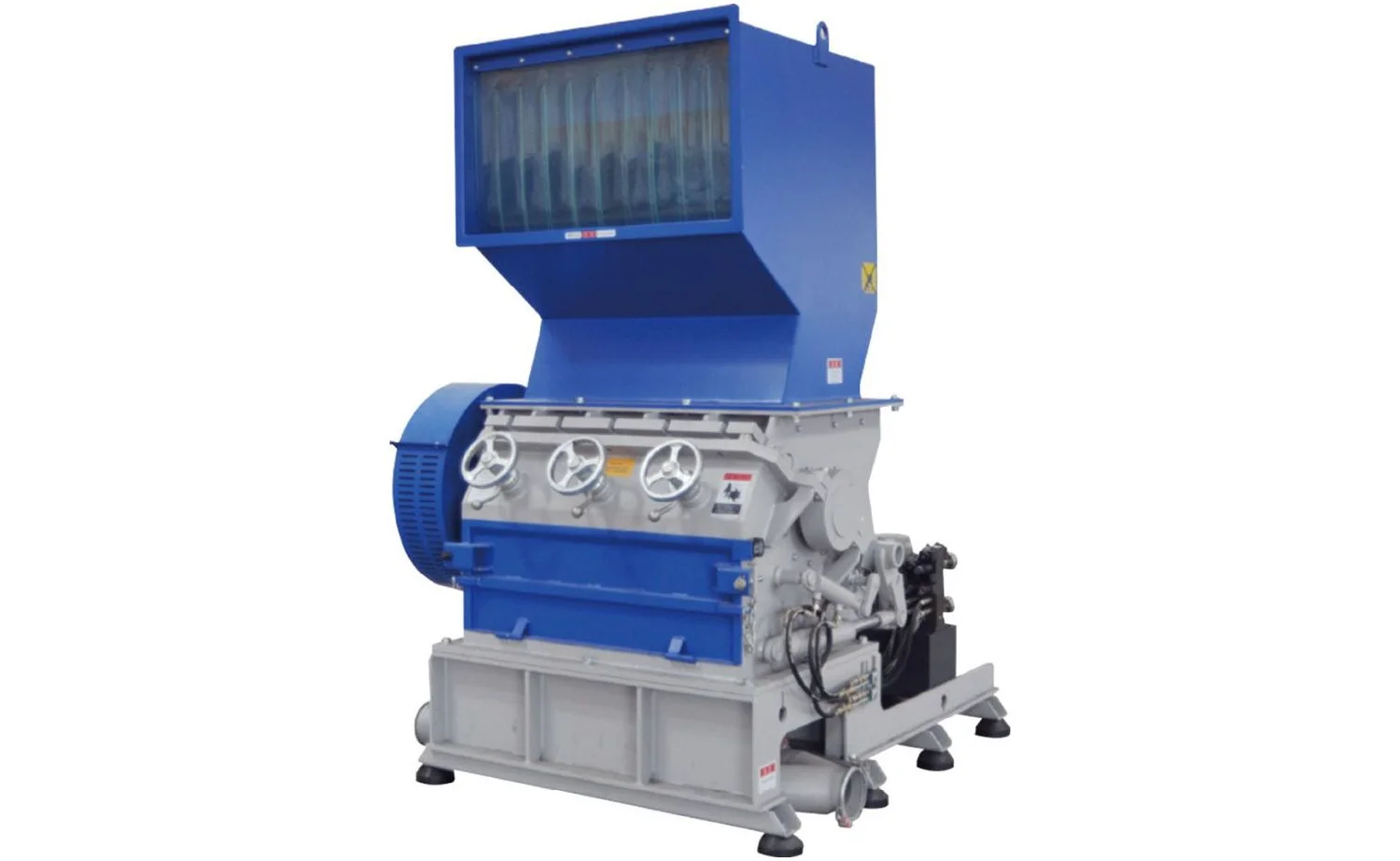
The ZXS-T uses a large 750 mm hard-faced rotor, available in widths from 1500 mm to 3000 mm, fitted with special knives and wear plates made of highly wear-resistant steel. The flat knives themselves use a highly wear-resistant tungsten carbide, chosen specifically for long working life when shredding abrasive and contaminated material. The rotor carries weld-on hard facing and has machined pockets that securely hold the knives and their holders, because on this material the knife mounting is under as much stress as the knife.
Shock loads, and the torque arm
Cutting tire is not a smooth process. Steel belting arrives at the knives irregularly, and every time it does the drivetrain takes a shock. Over months, those shocks are what fatigue a gearbox mounting.
The ZXS-T is driven by twin gear drives with oversized outboard bearings, and the oversized gearbox is supported by a very sturdy torque arm that cushions the shocks created while grinding tough material. It is an unglamorous component and it is one of the reasons the machine survives a job that punishes equipment.
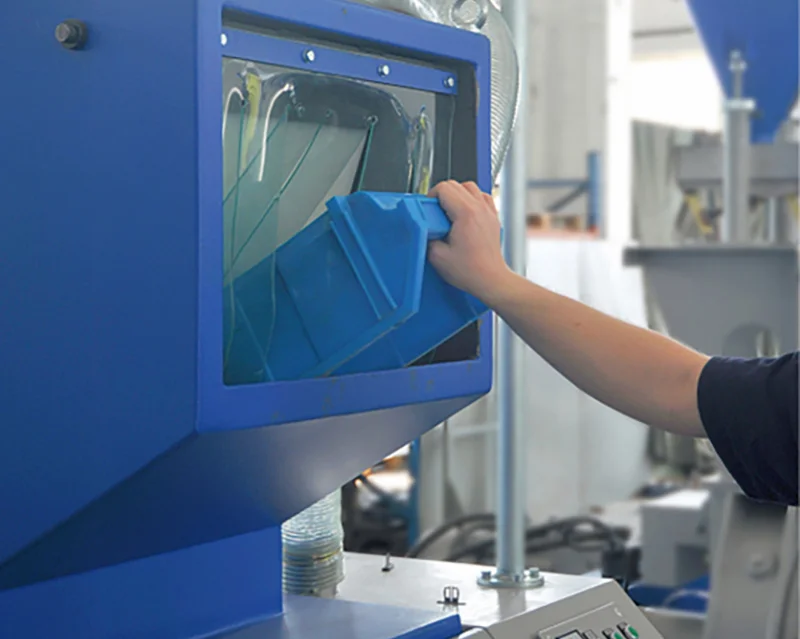
Feeding, by contrast, is deliberately simple. The ZXS-T uses a tangential infeed, which means it does not require a hydraulic feeding system at all. Whole tires go in without a ram, and an entire hydraulic subsystem, with its maintenance and its failure modes, is simply absent.
What it produces
| Input | Complete car tires, or large pieces of pre-processed truck and tractor tires |
| Output | Pre-shredded to approximately 150 mm using a single row of stator knives, ready for the next stage of a tire recycling line |
| Separation | With a 20 mm screen, the variable cutting gap produces material where steel is exposed for downstream magnetic separation |
| Other uses | Refuse-derived fuel (RDF) and other alternative fuel applications, where shredded tire material enters the fuel stream |
The dedicated machine or the heavy duty platform?
Worth being clear, because both are available and the right answer depends on your business rather than on which machine is better.
If tires are your primary business, the ZXS-T is the focused choice, built around tire material specifically. If tires are one of several tough streams you handle alongside plastics, e-waste, and general industrial scrap, the broader ZXS heavy duty platform may serve you better overall, since it covers complete truck and tractor tires with the appropriate wear protection while remaining versatile across everything else. That is a conversation about your material mix, and it is worth having before you buy rather than afterwards.
Send us the tires
Tire material varies, car against truck, whole against pre-processed, clean against contaminated, and separation quality is the thing you actually need to verify rather than take on trust. Ship us a sample of your actual tire material. Tell us your volume and whether you are targeting steel separation or an RDF stream. We run it at our Fort Myers facility, film the test, and send you the footage with a confidential technical analysis, so you can see how your material comes apart before you commit.
Our YouTube channel carries ZERMA shredder demonstrations under demanding operating conditions.
Wear parts are the running cost
On tire material more than any other, knives, wear plates, and screens are the consumable that defines your operating cost. Replacements are stocked at Virtus Equipment Direct, our online parts store, so a worn part is an order rather than a quote and a week of lost production. Our service team handles installation, commissioning, operator training, and maintenance scheduling, and our service line is bilingual in Spanish.
Frequently asked questions
Can the ZXS-T shred whole tires?
Yes. It processes complete car tires, or large pieces of pre-processed truck and tractor tires, pre-shredding them to approximately 150 mm with a single row of stator knives. The tangential infeed takes them without a hydraulic ram.
How does it separate steel from rubber?
Through the cutting gap rather than through any separation device of its own. The variable cutting gap, paired with a 20 mm screen, produces material in which the steel is exposed and freed enough to be pulled out by magnetic separation equipment downstream. Clean separation is what makes the recovered material valuable.
Why tungsten carbide knives?
Because tires are abrasive and contaminated, which destroys ordinary knives quickly, and knife life is one of the main variables in tire recycling economics. The flat knives use a highly wear-resistant tungsten carbide, and the rotor carries weld-on hard facing, specifically so the machine keeps running rather than keeps stopping.
Do I need the dedicated tire machine, or will the heavy duty ZXS do?
It depends on your material mix. If tires are your primary business, the ZXS-T is the focused, optimised choice. If tires are one of several tough streams alongside plastics and industrial scrap, the broader ZXS heavy duty platform with tire wear protection may serve you better across the whole operation.
Terms worth knowing
Variable cutting gap. An adjustable clearance in the cutting zone which, paired with the right screen, governs how effectively steel and rubber are separated from each other. On a tire shredder this is the specification that determines the value of your output.
Magnetic separation. The downstream process that pulls freed steel out of shredded tire material. It only works if the shredder has exposed the steel properly in the first place.
Tungsten carbide knives. Highly wear-resistant flat knives selected for long working life on abrasive and contaminated material such as tire.
Torque arm. The support that cushions the shock loads the drivetrain absorbs when steel belting hits the knives, protecting the gearbox mounting over the long run.
Tangential infeed. A feed geometry that accepts whole tires without a hydraulic ram, removing an entire subsystem and its maintenance from the machine.
Related ZERMA machines
- ZXS heavy duty shredder for mixed tough streams where tires are one material among several
- ZSS general purpose shredder for plastics and general recycling
- ZIS big volume shredder for bulky containers and drums
- ZRS pipe and profile shredder for large diameter pipe