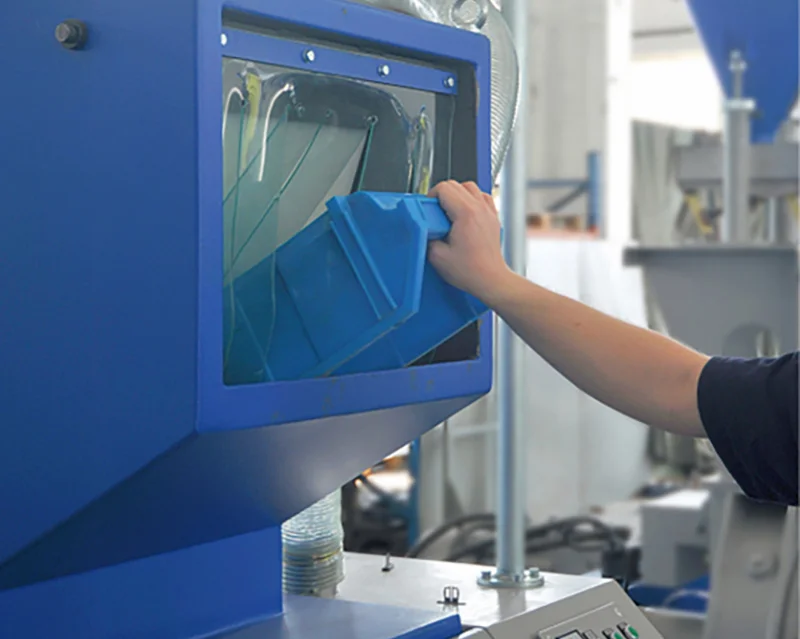
A one-gallon HDPE jug weighs about two ounces. It also occupies roughly 231 cubic inches of space. That ratio, almost all volume and almost no mass, is the entire reason bulky plastics are difficult to granulate, and it is worth understanding properly before you buy a machine to handle them.
A conventional granulator relies on gravity. Material drops from the hopper onto the cutting circle, and its own weight holds it there long enough for the knives to engage. That works beautifully for a sprue, which is dense and compact. It fails for a jug, which is light enough to be batted around by the airflow the rotor itself generates. The part rides on top of the cutting circle instead of dropping into it, and you get noise, wasted energy, and a machine that looks broken but is not.
The problem is bulk density, not strength
Processors often assume a part that will not feed must be too tough for the machine. Usually the opposite is true. Thin-walled bottles and crates are easy to cut. They are simply hard to catch.
Bulk density is the metric that matters here: mass per unit of volume as the material actually presents itself. Regrind has a high bulk density. Baled film has a moderate one. A pile of empty canisters has a very low one, and low bulk density means the rotor spends its energy moving air and pushing parts around rather than shearing them. Add the fact that hollow parts trap air and resist compression, and you have material that actively fights a gravity-fed chamber.
No amount of horsepower fixes this. The rotor is not failing to cut. It is failing to make contact.
The engineering answer: change the approach angle
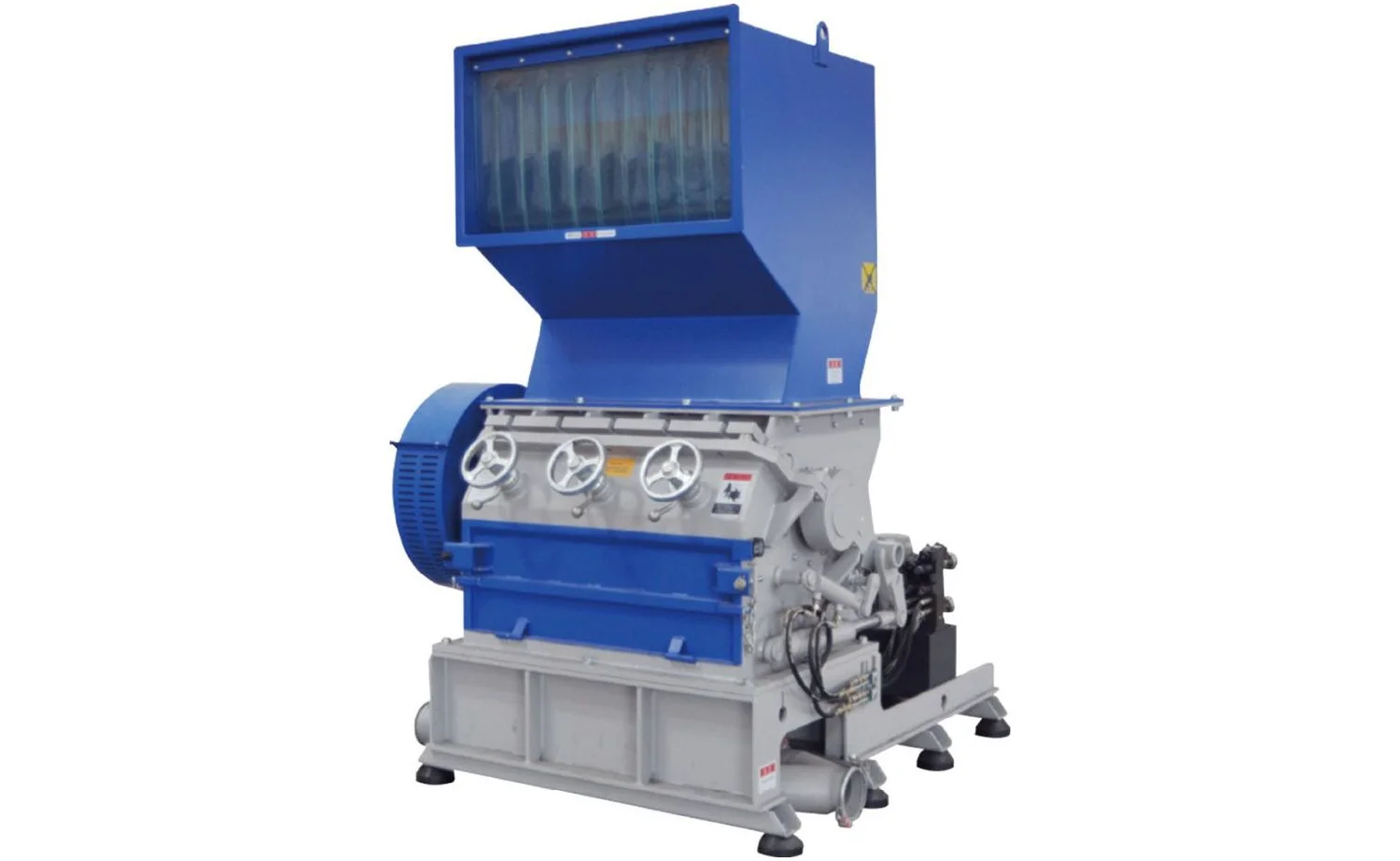
The GST solves the problem by changing where the material meets the rotor. Rather than dropping straight down onto the cutting circle, material is directed into the rotor at an angle, along a tangent to the circle rather than perpendicular to it. Instead of waiting for the part to fall into the knives, the geometry drives the knives into the part.
Two design elements make it work. The rotor is open and aggressive, which grabs light material on the first pass instead of deflecting it. And the cutting chamber has a curved back wall, which does something subtle but important: it keeps parts moving through the cutting zone instead of letting them wedge into a corner. Aggressive ingestion without blockages is the specific combination this geometry is built to deliver.
Configuration
| Rotor diameters | 250 mm and 400 mm |
| Working widths | 300 mm to 1000 mm |
| Rotor type | Open F-type rotor on the smaller machines, heavier S-type rotor on the larger |
| Cutting chamber | Offset tangential feed with a curved back wall, plus replaceable wear plates |
| Maintenance | Rotor and stator knives adjusted outside the machine, which keeps downtime short |
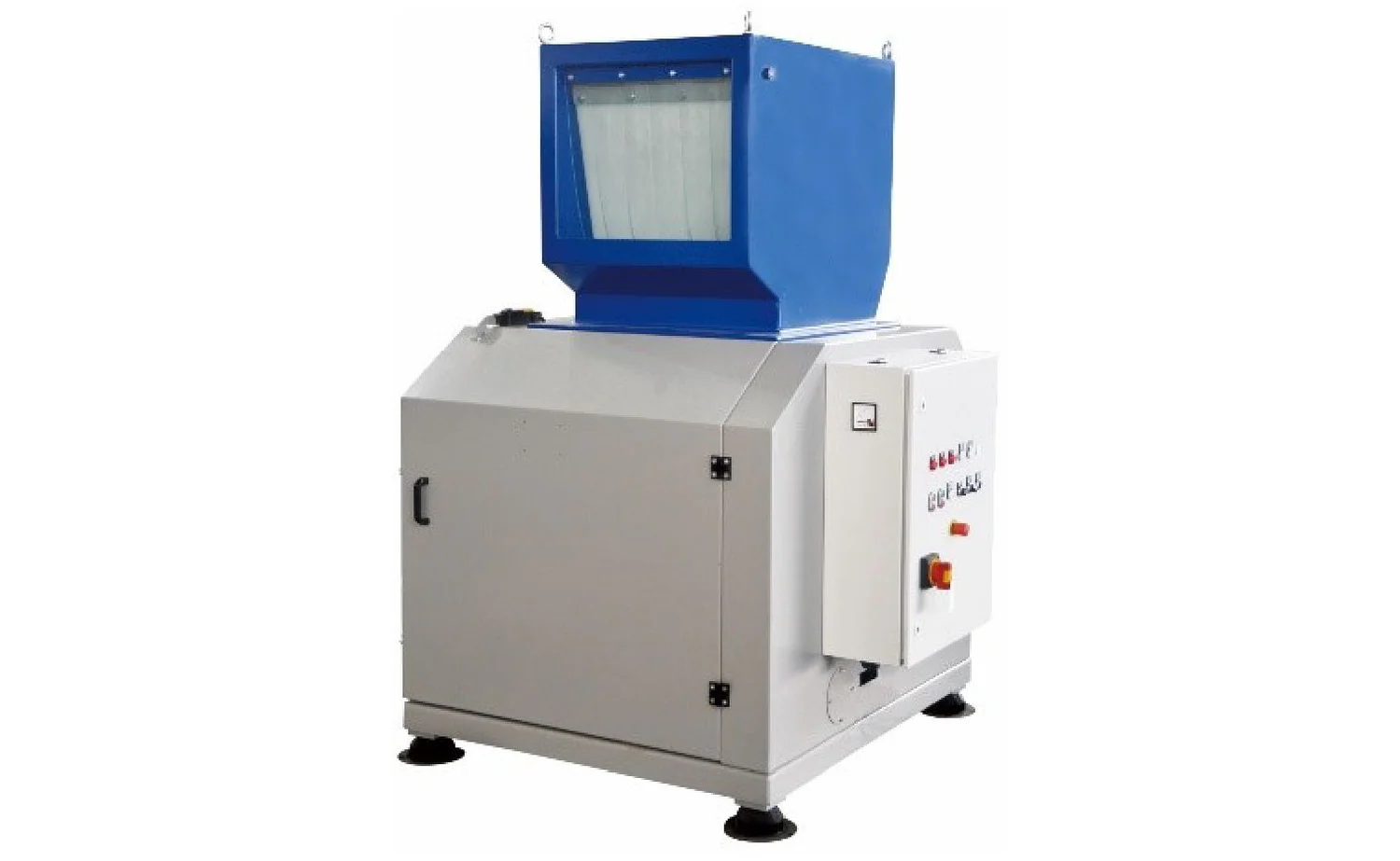
| Noise | Compact soundproofed enclosure with sound-dampening hoppers, same as the GSC family |
Which material actually calls for this
It is the right machine for: blow-molded bottles, jugs, canisters, and containers; blow molding flash; crates, totes, and rigid bulky parts full of trapped air; and thin-walled packaging that a straight-drop chamber cannot hold onto. It also handles injection sprues perfectly well, so a shop with a mixed stream is not forced to buy two machines.
It is the wrong machine for: small dense scrap alone, where a straight-drop GSC is more economical. And bulky is not the same as tough: purge lumps, thick pipe, film bales, denim and other textiles, and tires all need a shredder ahead of any granulator.
Ingestion is the one thing you cannot judge on paper
Cutting capacity can be calculated. Feeding behavior really cannot, because it depends on the exact geometry, wall thickness, and stiffness of your specific part. This is the application where a material trial earns its keep more than any other.
Our YouTube channel shows ZERMA machines processing a range of materials, and that is a reasonable place to start.
Better still, ship us a box of the parts that are giving you trouble. We run them at our Fort Myers facility, film the test, and send you the footage with a confidential technical analysis. If a cheaper straight-drop machine would serve you just as well, we will say so.
Keeping it running
Wear plates, knives, and screens are consumables on any granulator. Replacements are stocked at Virtus Equipment Direct, our online parts store, so a worn part is an order rather than a quote and a week of waiting. Our service team handles installation, commissioning, and operator training, and our service line is bilingual in Spanish.
Frequently asked questions
What is a tangential granulator, in one sentence?
It is a granulator whose cutting chamber is offset so material enters the rotor at an angle rather than dropping straight onto it, which lets it grab bulky hollow parts that a conventional chamber cannot hold onto.
My parts are not heavy. Why does my current granulator struggle?
Almost certainly because they are not heavy. Light, hollow parts have low bulk density and trap air, so gravity does not press them into the cutting circle and the rotor’s own airflow pushes them around. That is an ingestion problem, not a power problem, and adding horsepower will not fix it.
Can a GST also grind sprues and small parts?
Yes. It handles dense small scrap alongside bulky material, so a mixed stream can run on one machine. The tangential geometry simply earns its cost on the awkward items.
Is it as quiet as the other soundproofed models?
Yes. The GST uses the same compact soundproofed enclosure and sound-dampening hoppers as the GSC family, so good ingestion does not cost you a quiet floor.
Terms worth knowing
Bulk density. Mass per unit of volume as the material actually presents itself in the hopper. Low bulk density, which is what bottles and crates have, is the root cause of most feeding problems.
Tangential feed. A geometry where material enters the rotor along a tangent to the cutting circle rather than perpendicular to it, so the knives drive into the part instead of waiting for the part to fall into the knives.
Ingestion. The machine’s ability to actually capture material and pull it into the cutting zone, which is a separate question from whether it has the power to cut that material once it gets there.
Cutting circle. The circle swept by the rotor knife tips. Its diameter is one of the primary indicators of a granulator’s capacity.
Wear plates. Replaceable liners inside the cutting chamber that take the abrasion, so the chamber itself does not have to be rebuilt.
Related ZERMA machines
- GSC compact soundproofed granulators for dense, small scrap where noise is the constraint
- GSL slow speed granulators for press-side sprues and runners
- GSH heavy duty granulators for thick-walled parts
- ZIS big volume shredder when the containers are too large to granulate at all