Machines do not fail randomly. Put a granulator on material it was not designed for and it will fail in a specific order, in specific places, and usually with a fair amount of warning that nobody was watching for. Understanding that order is the most useful thing a buyer of industrial equipment can do, because it tells you exactly what you are paying for when you spend up.
Here is what actually goes wrong, and what engineering against it looks like.
Failure mode one: the bearings
This is the classic, and it is almost always a design problem rather than a maintenance one. If a granulator’s bearings sit inside or adjacent to the cutting chamber, then every gram of dust, fines, and contaminated material the machine produces is being generated a few inches from a precision component that hates all three. Material works its way in, the bearing degrades, and it fails early. Worse, the lubricant works its way out, into your regrind, which is a contamination problem you may not discover until it is downstream in a molded part.
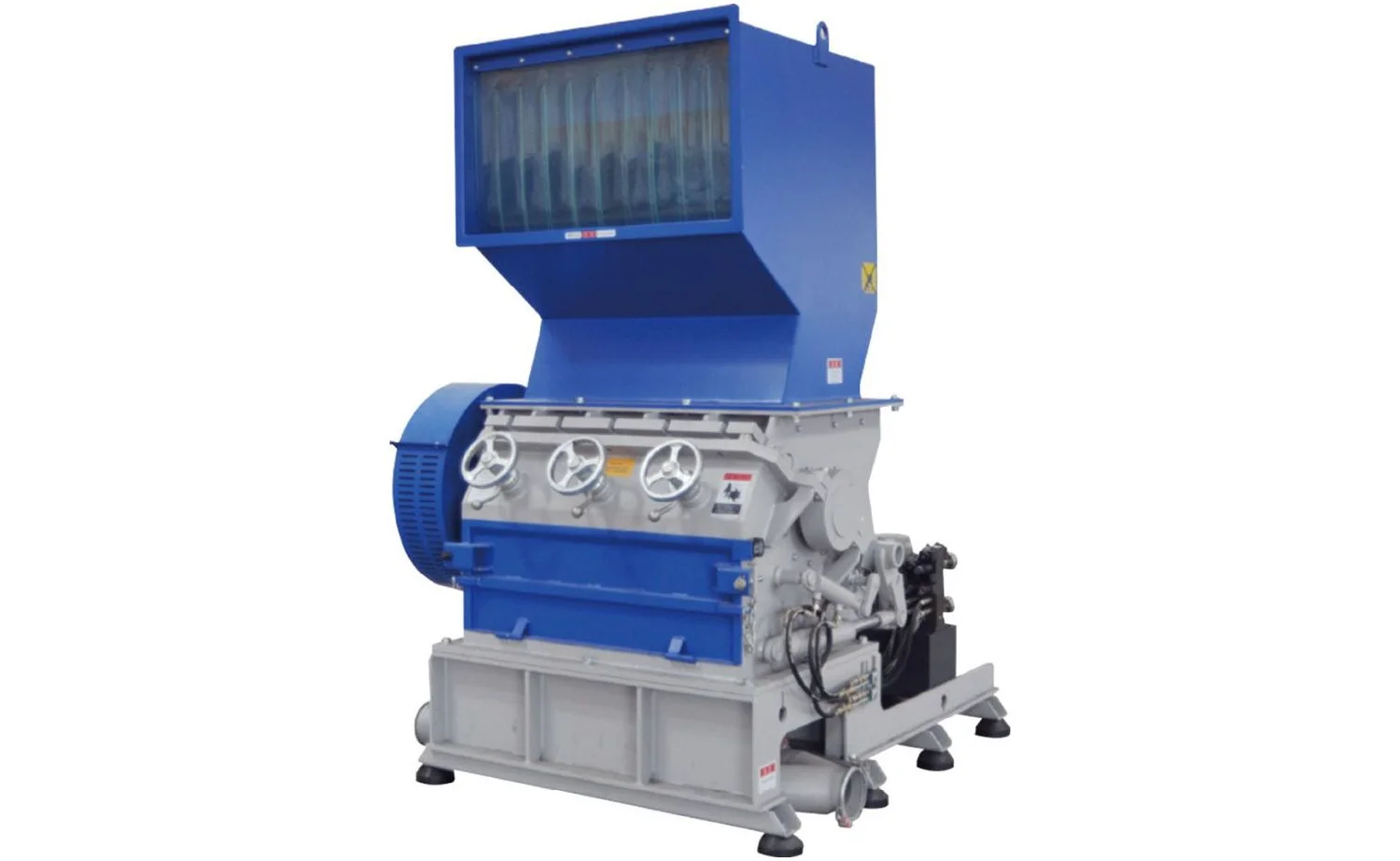
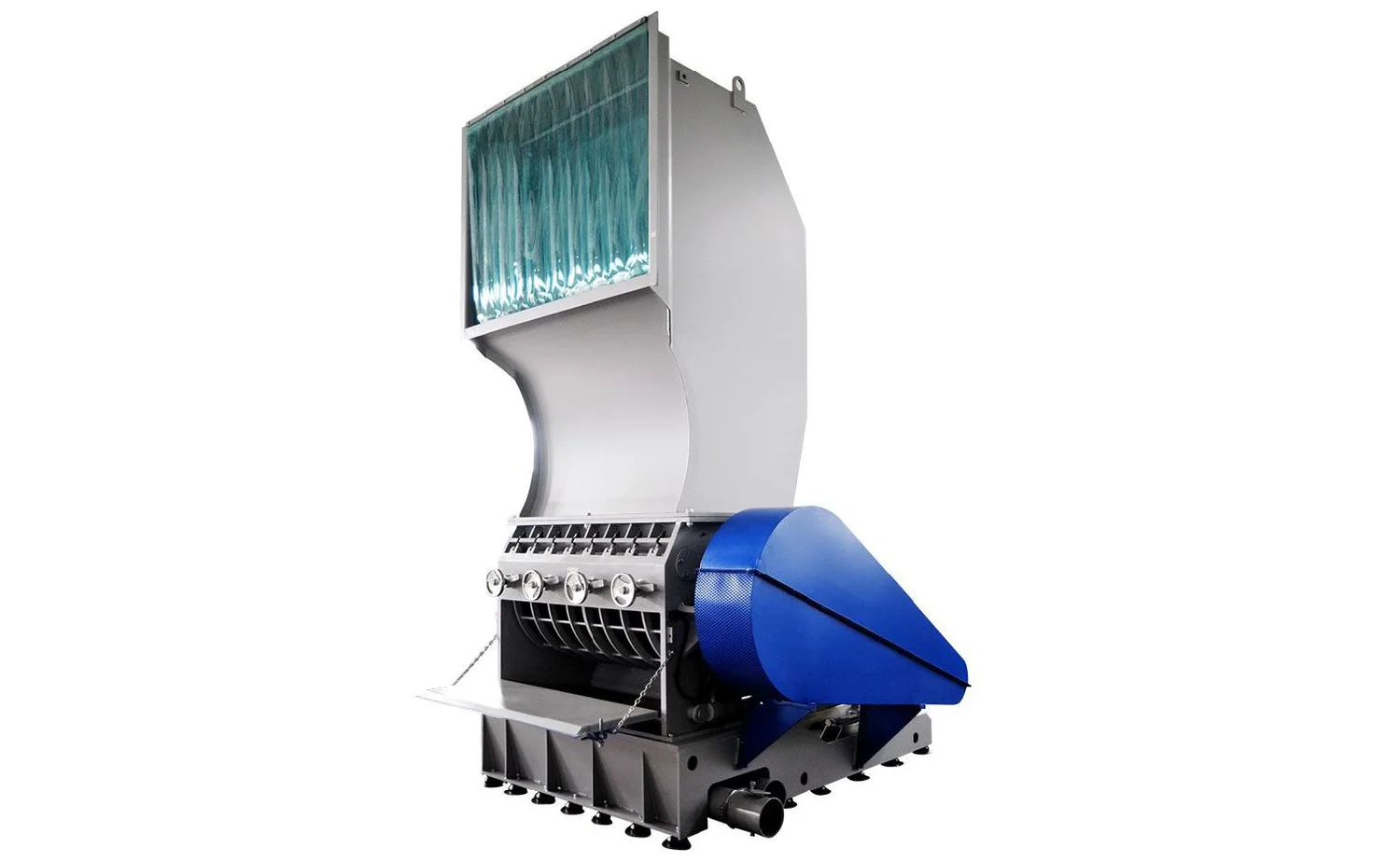
The GSH is built with outboard bearings, meaning they sit outside and separated from the cutting chamber entirely. That is not a small refinement. It is the difference between a bearing that lives a full service life and one that becomes a recurring line item, and it is the single most important thing to check when you compare industrial granulators.
Failure mode two: the shaft and knife mounts
Thick-walled material does not cut so much as it resists. Every time a knife engages a heavy section, the load travels back through the knife mount and into the rotor shaft. On a machine sized for lighter work, those loads accumulate as fatigue in exactly the components you cannot easily replace.
The GSH answers this with mass in the right places: the rotor bearings, knife mounts, and rotor shaft are all oversized specifically to meet the loads of industrial recycling. That is what makes single-step processing of thick-walled scrap realistic rather than merely possible.
Failure mode three: abrasion, which is not the same as force
Glass-filled resin, contaminated post-consumer material, and mineral-loaded compounds do not overpower a machine. They erode it. The cutting chamber surfaces wear, clearances open up, cut quality drifts, and eventually you are rebuilding a housing rather than replacing a wear part.
Two design decisions address this. The cutting chamber uses easily replaceable wear plates, so the surfaces that take the abuse are consumable by design rather than structural. And for genuinely abrasive applications, the rotor’s key parts can be manufactured from highly wear-resistant steel with weld-on hard facing, which dramatically extends life on filled and contaminated material. If your feedstock is abrasive, specify this up front. Retrofitting wear protection after the fact is always more expensive than ordering it.
The deflector wedge, and why aggressivity is adjustable
One feature on the GSH is worth calling out because it is unusual. The machine has a removable deflector wedge that houses a third stator knife, and it lets you adjust the granulator’s aggressivity to match different materials. In practice that means one machine can be tuned for different jobs rather than being locked into a single cutting behavior, which matters when your material mix is not constant.
Underneath it all, the rotors use V-cut technology, which produces a high-quality granule with a very low percentage of fines. Low fines matter more at industrial volume than anywhere else, simply because the wasted material scales with the throughput.
The range
| Model | Rotor diameter | Working widths |
| GSH 350 / 500 | 350 and 500 mm | 500 to 1000 mm |
| GSH 600 / 700 | 600 and 700 mm | 800 to 1000 mm |
| GSH 800 | 800 mm | 1200 to 2000 mm |
| GSH 1100 | 1100 mm | 1200 to 2400 mm, with 9, 11, or 13 rows of rotor knives |
The smaller models are mainly deployed as central granulators for in-house recycling, taking thick-walled pieces down in a single step rather than requiring a pre-cut. The GSH 1100 is built for large thick-walled parts in one pass, and the choice of knife rows lets you match throughput to volume.
Running it as a second stage
Not every heavy duty granulator works alone. Every GSH can run as a second-step granulator after a shredder to reach higher throughput rates, which is the standard architecture when the incoming material is genuinely bulky. And when the material is light, a force-feeding device keeps the rotor fed rather than letting it spin through air, which can increase throughput substantially.
Do not buy this machine on faith
A GSH is a significant investment, and the variables that determine whether it is sized correctly, wall thickness, abrasiveness, throughput, and whether it runs standalone or after a shredder, interact in ways that a spec table cannot resolve. Send us a sample of your actual thick-walled parts, purge, or abrasive scrap. We run it at our Fort Myers facility, film the test, and send you the footage with a confidential technical analysis. On a purchase this size, seeing your hardest material go through first is simply how it should be done.
Our YouTube channel has equipment demonstrations across the ZERMA range if you want to see the machines working first.
Wear parts are a plan, not a surprise
On an industrial machine, wear plates, knives, and screens are consumed on a schedule. The only question is whether you are ready for it. Replacements are stocked at Virtus Equipment Direct, our online parts store, so a worn part is an order rather than a quote and a week of lost production. Our service team handles installation, commissioning, operator training, and maintenance scheduling, and our service line is bilingual in Spanish.
Frequently asked questions
Why do bearings matter so much in a granulator?
Because of where they sit. Bearings located inside or beside the cutting chamber are exposed to the dust and fines the machine itself creates, which shortens their life, and their lubricant can migrate into your regrind and contaminate it. The GSH places bearings outboard, outside and separated from the chamber, which addresses both problems at the design level rather than the maintenance level.
What is the difference between a heavy duty and a standard central granulator?
Welded heavy steel construction with an oversized rotor shaft, bearings, and knife mounts. That is what allows single-step grinding of thick-walled and tough material. A standard central granulator handles everyday medium-volume recycling but is not built for the loads of industrial scrap.
My material is abrasive. What should I specify?
Wear protection, and specify it before you buy. Hard facing on the rotor and housing, plus key parts in highly wear-resistant steel, dramatically extends life on filled, contaminated, and abrasive material. Retrofitting this later always costs more than ordering it with the machine.
Can a GSH run after a shredder?
Yes, and for bulky feedstock that is the normal architecture. All GSH machines can serve as a second-step granulator to reach higher throughput. For light material, a force-feeding device keeps the rotor fed and lifts throughput further.
Terms worth knowing
Outboard bearings. Bearings mounted outside and separated from the cutting chamber, which keeps material and contamination away from them and keeps lubricant out of the regrind. On an industrial machine this is a primary specification, not a detail.
Deflector wedge. A removable wedge that houses a third stator knife and allows the granulator’s aggressivity to be tuned to different materials.
Hard facing. A wear-resistant layer welded onto the rotor and housing so the machine survives abrasive, filled, or contaminated feedstock.
Wear plates. Replaceable liners in the cutting chamber that are consumed by design, so abrasion does not force a housing rebuild.
Second-step granulator. A granulator running downstream of a shredder, which is the standard configuration when the incoming material is too bulky to granulate directly.
Related ZERMA machines
- GSE economical granulators for everyday medium-volume recycling that does not need industrial construction
- GSL slow speed granulators for clean press-side scrap
- ZSS general purpose shredder for bulky first-stage size reduction
- ZXS heavy duty shredder for the toughest, highest-throughput pre-shredding