Every machine in a size reduction line fights friction. The pulverizer is the only one where friction is simultaneously the working principle and the primary failure mode.
Grinding plastic into fine powder means driving it between discs at high speed, and that process generates heat by definition. Push it slightly too hard and the heat rises past the point where the polymer softens. The powder you were making fuses back together into clumps, a phenomenon called sintering, and the batch is ruined. Not degraded, ruined, because the whole reason your downstream process wanted powder was that it needed powder.
Understanding that constraint explains almost everything about how a pulverizer is designed and why the unglamorous parts of it matter more than the impressive ones.
First, why powder at all
Worth being clear about the destination before discussing the machine. A granulator makes granules roughly the size of virgin pellets, which is what an injection molder or extruder wants. Certain processes cannot use that material at any size.
Rotational molding is the clearest case. A rotomolder heats a mold and rotates it slowly so the material coats the walls evenly, and that only works with powder. Granules will not disperse and melt uniformly across the mold surface. It is not a preference, it is a physical requirement of the process, which is why polyethylene destined for rotomolding is pulverized first.
PVC pipe production is the other major case. Pipe extrusion runs on powder feedstock, so regrind recovered from pipe and profile scrap can only re-enter the production cycle after it has been pulverized back into powder. Compounding operations and powder coating recovery round out the list. In every one of these, the pulverizer is the step that turns recovered material back into something the process will actually accept.
How the PM grinds
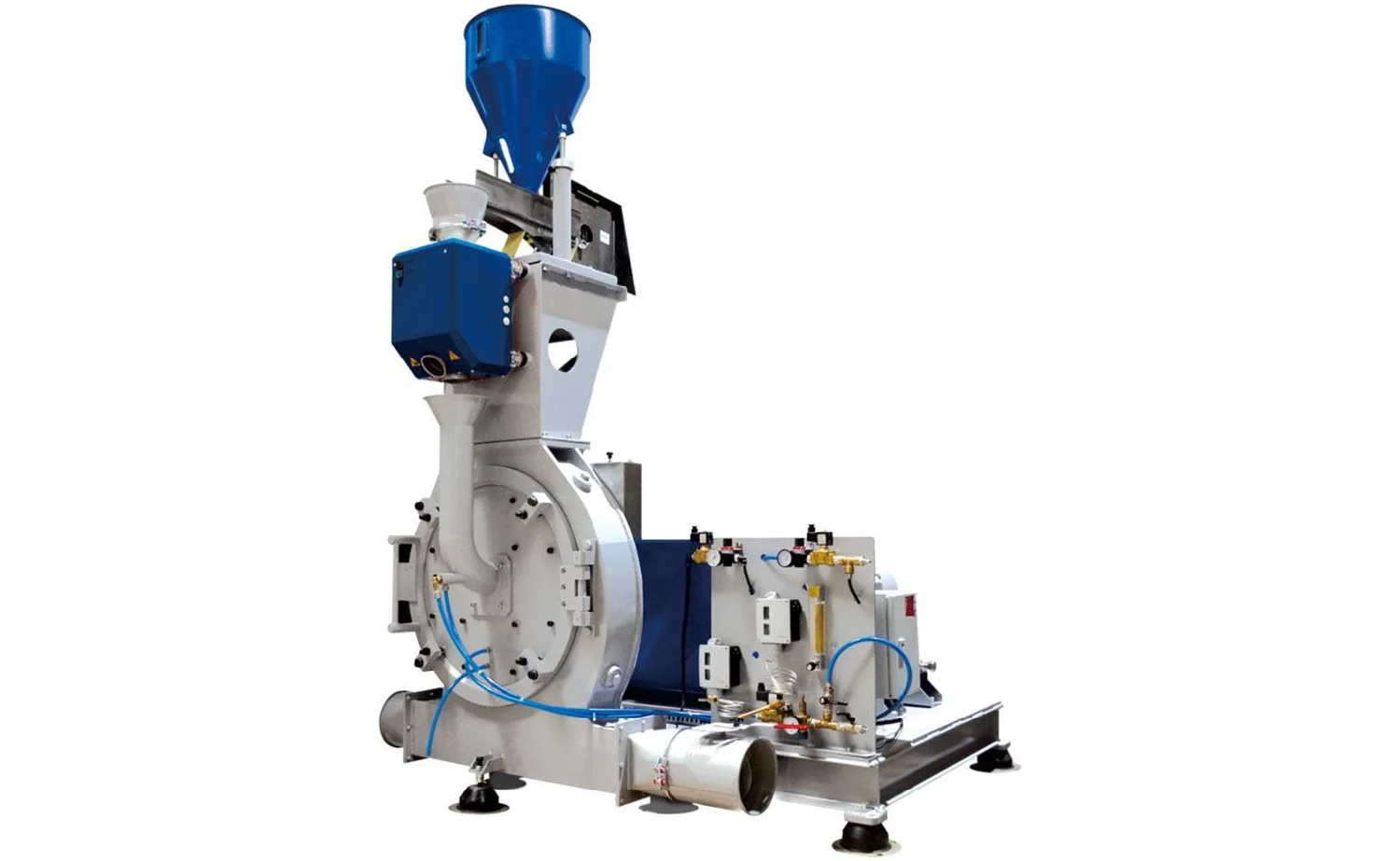
The mechanism differs fundamentally from every cutting machine in the range. There are no knives shearing against a stator. Instead, material is introduced through the centre of a vertically fixed grinding disc, which is mounted concentrically with an identical high-speed rotating disc. Centrifugal force carries the material outward through the grinding zone between the two discs, and the combination of friction and impact reduces it to fine powder. A blower and cyclone system then collects the finished material.
The discs themselves are made of high-quality tool steel and can be treated to resist wear, and depending on the application the machine can be equipped with one-piece grinding discs or grinding segments. Disc condition is directly tied to output consistency, which makes them a maintenance item worth watching rather than ignoring.
| Disc diameters | 300 mm to 800 mm |
| Discs | One-piece grinding discs or grinding segments, in high-quality tool steel that can be treated to resist wear. Both can be resharpened. |
| Feed | Vibrating dosing channel, with feed rate automatically adjusted by motor amperage and material temperature |
| Collection | Blower and cyclone system |
The part that actually determines whether it works
Here is where the heat problem gets solved, and it is not in the grinding chamber. It is in the feed.
Material reaches the discs through a vibrating dosing channel, and the feed rate is automatically adjusted based on two inputs: the motor’s amperage and the material temperature. That second input is the one that matters. The machine is not simply metering material to avoid overload. It is watching the thermal condition of what it is grinding and backing off before the powder starts to sinter.
Feed too fast and you generate heat faster than it can dissipate. Feed too slow and you have bought throughput you are not using. A pulverizer without closed-loop feed control is a machine that requires an operator to babysit it, and operators, being human, will occasionally be somewhere else when the temperature climbs.
The pulverizer is the last stage, not the only one
A common misunderstanding is that a pulverizer can take scrap directly. It generally cannot, and it should not be asked to. Powder production is the end of a sequence.
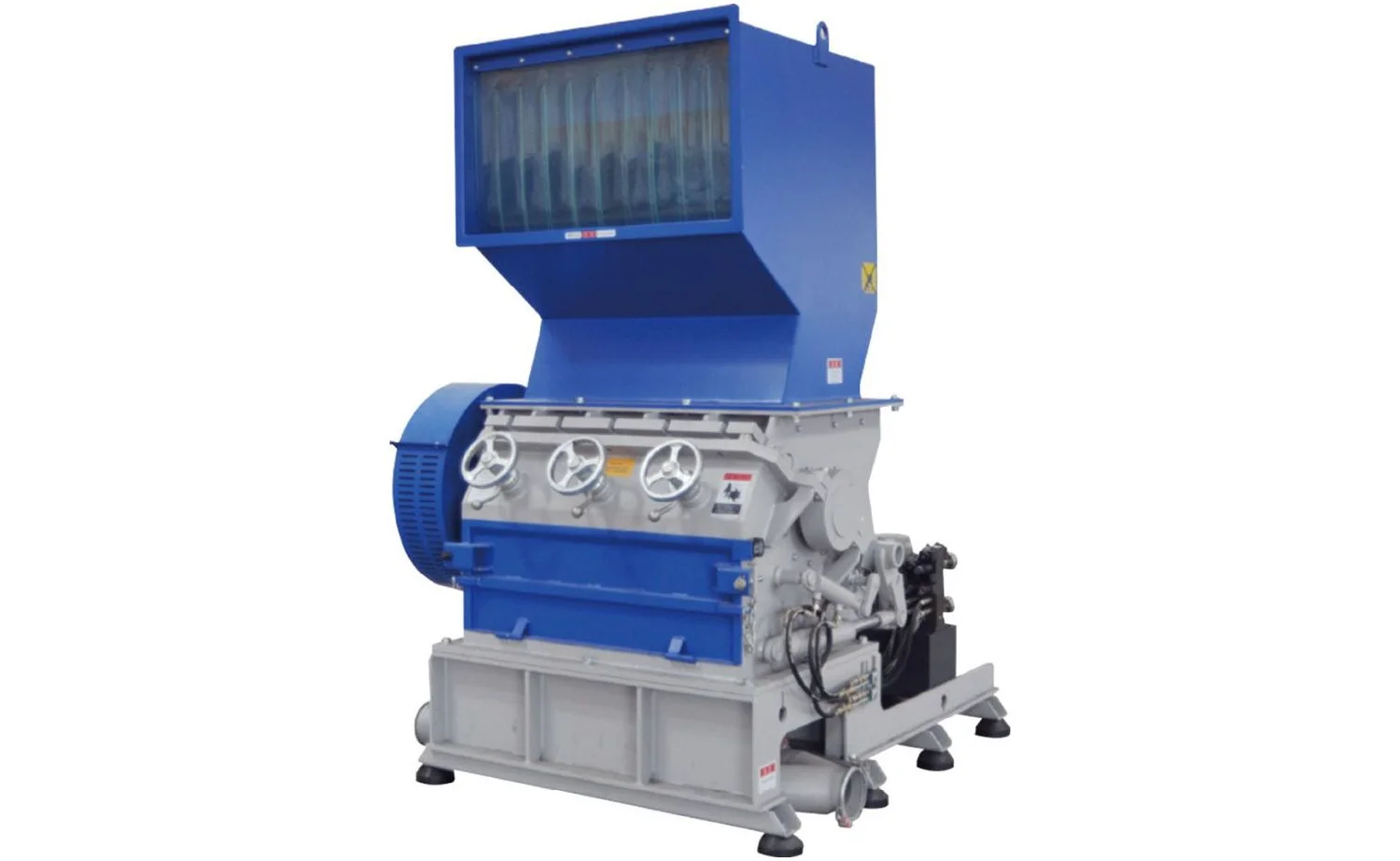
Shredder
Granulator
PM Pulverizer
Feeding properly sized, consistent regrind is what allows the pulverizer to produce consistent powder. Running it in line with a shredder and a granulator is the standard architecture, and pulverizing PVC pipe and profile regrind is one of the main jobs the PM Series was built for.
A note on fineness
Powder applications are specified by particle size, and different processes want different ranges. It is worth resisting the instinct that finer is automatically better. Finer powder costs more energy, more disc wear, and more heat, which is the very thing you are trying to control. The right target is whatever your downstream process actually requires, and no finer. Overbuilding for fineness you do not need is a real and avoidable expense.
This is the machine you should never buy untested
Particle size, flow behaviour, and how a given material responds to the heat of pulverizing are genuinely difficult to predict on paper, and they are precisely what your downstream process is sensitive to. Send us a sample of your regrind or scrap. Tell us the target application and powder specification. We run it at our Fort Myers facility, film the test, and send you the footage plus a confidential technical analysis, including sample output you can evaluate against your own process requirements.
Our YouTube channel also carries demonstrations across the ZERMA range, including pulverizer systems.
Discs are consumables
Grinding discs and segments wear, and worn discs show up as inconsistent output long before they show up as a failure. Replacement wear parts are available through Virtus Equipment Direct, our online parts store. Our service team handles installation, commissioning, operator training, and maintenance scheduling, and our service line is bilingual in Spanish.
Frequently asked questions
What is sintering, and why does it matter?
Sintering is what happens when the heat generated during pulverizing softens the polymer enough that the powder particles fuse back together into clumps. It ruins the batch, because the downstream process wanted powder specifically. It is the main reason feed rate and temperature are controlled rather than left to an operator’s judgement.
What is the difference between a granulator and a pulverizer?
A granulator cuts plastic into granules roughly the size of virgin pellets. A pulverizer grinds material into fine powder, which processes like rotational molding and PVC pipe compounding physically require and cannot substitute granules for. They are different machines producing different products, not two sizes of the same thing.
Can I feed scrap straight into a pulverizer?
Generally no. A pulverizer is the last stage of a shred, granulate, pulverize line. Bulky scrap is broken down and granulated first, and feeding properly sized regrind is what allows the machine to produce consistent powder.
Is finer powder always better?
No, and assuming so is expensive. Finer powder costs more energy, more disc wear, and generates more heat, which is the constraint you are working against. Specify the fineness your downstream process actually needs and no more.
Terms worth knowing
Sintering. The fusing of powder particles back into clumps when pulverizing generates more heat than the material can tolerate. It is the failure mode the entire feed-control system exists to prevent.
Disc pulverizer. A machine that grinds material between a fixed disc and a concentric high-speed rotating disc, using friction and impact rather than knives and shearing.
Dosing channel. The vibrating feed that meters material into the grinding zone, with its rate automatically adjusted based on motor amperage and material temperature.
Cyclone collection. The blower and cyclone system that separates finished powder from the airstream and moves it to storage.
Three-stage line. The shred, granulate, pulverize sequence used to take bulky scrap all the way down to powder, with each machine doing the job it was designed for.
Related ZERMA machines
- GSP pipe and profile granulators that produce the regrind a PVC pulverizer feeds on
- ZRS pipe and profile shredder for the first stage on large diameter pipe
- GSH heavy duty granulators for thick-walled parts
- ZCS shredder-granulator combination for two stages in one footprint