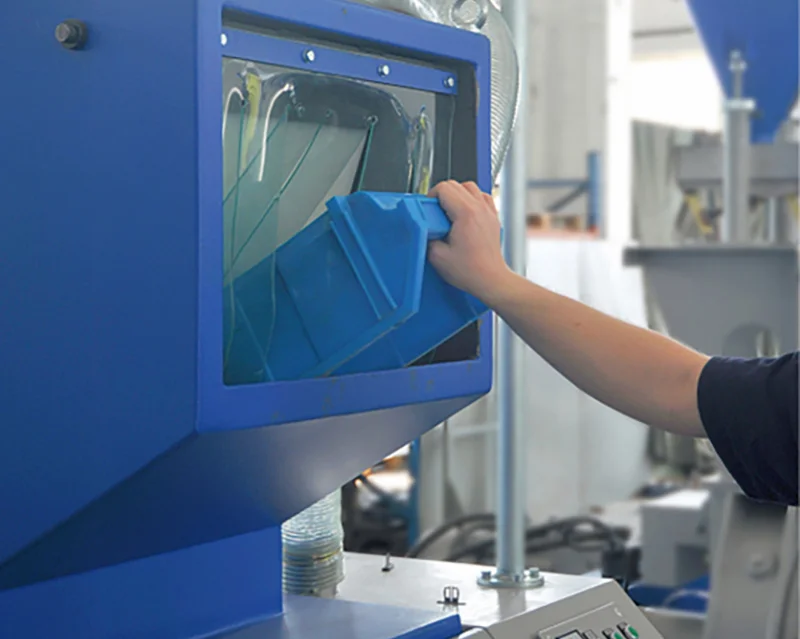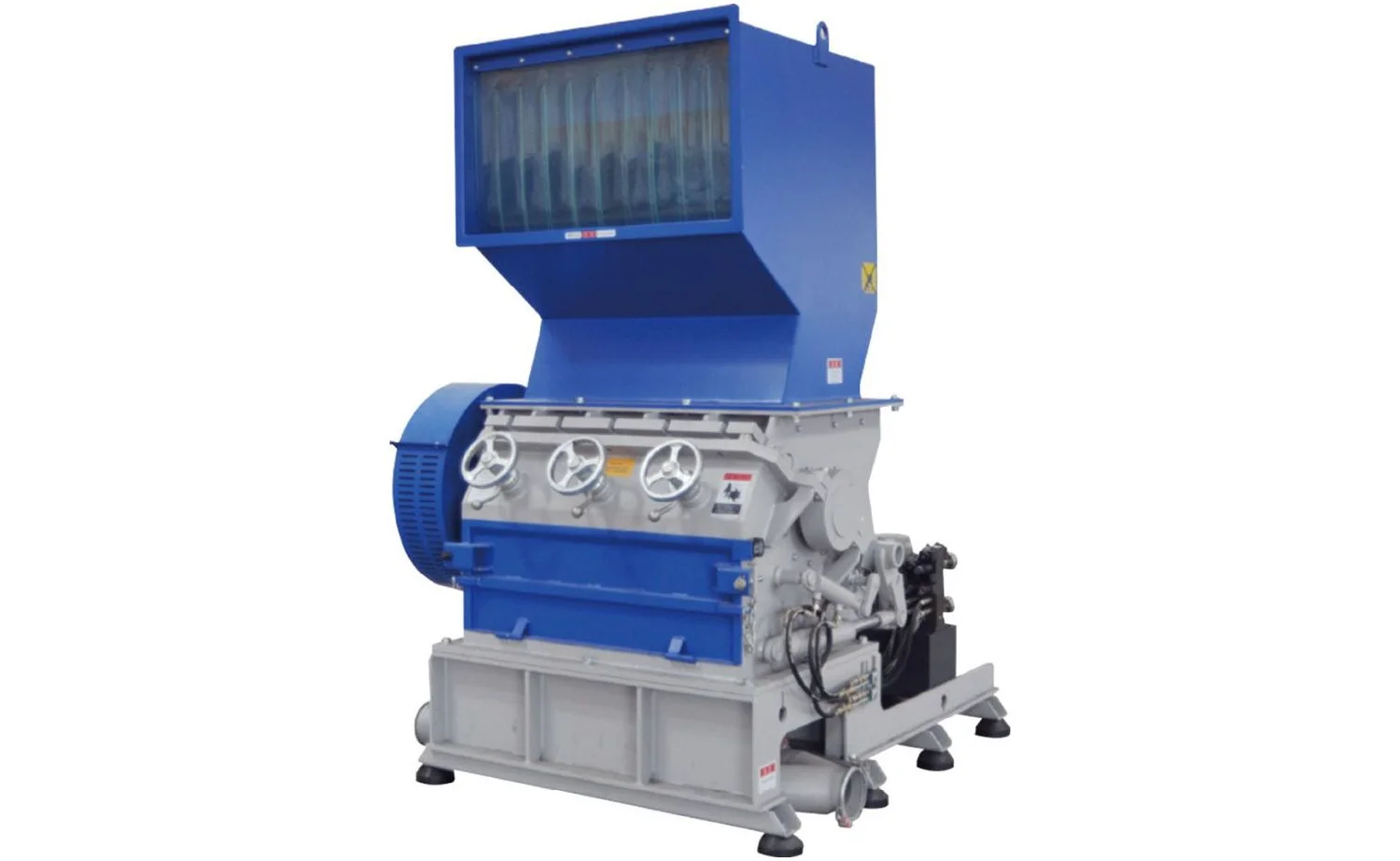
Most plastics recycling conversations focus on granulation because granulation is the right answer for most applications. Regrind that blends back into an injection mold, an extruder, or a blow molding press needs to be in granule form, roughly the same size as virgin resin pellets, to feed and process consistently.
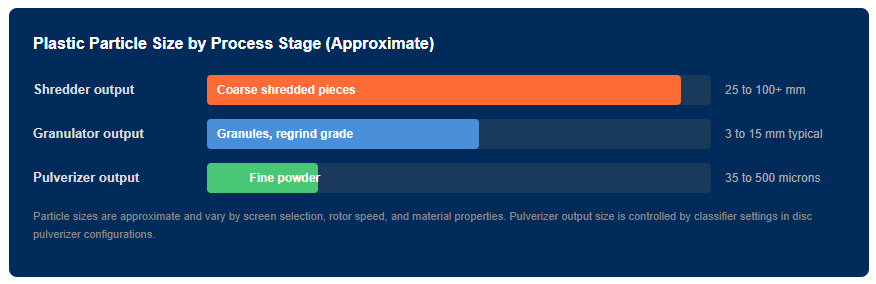
But there is a category of applications where granules are not the right output. Rotational molding, powder coatings, PVC pipe remanufacturing, and a growing range of specialty compounding operations need their plastic feedstock in powder form, typically in the range of 35 to 500 microns. You cannot get to that particle size with a standard granulator. You need a pulverizer, and the process to get there is fundamentally different.
Granulation vs. Pulverization: The Output Difference
How the PM Disc Pulverizer Works
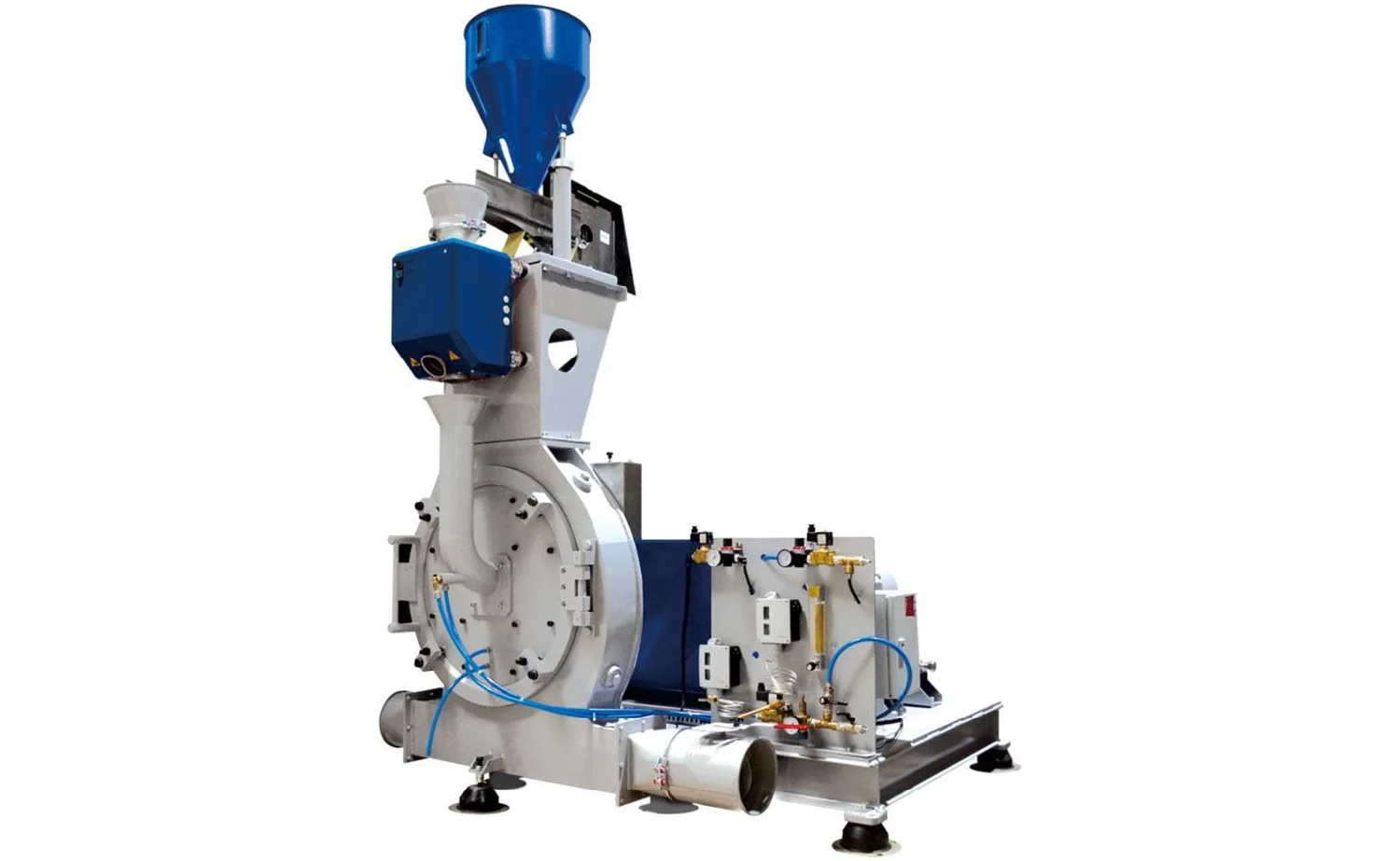
ZERMA America’s PM Plastics Pulverizer uses a disc-on-disc grinding mechanism. Granulated plastic is fed between two discs, one stationary and one rotating at controlled speed. The gap between the discs determines the final particle size, and a classifier system separates on-spec powder from oversized particles that recirculate through the grinding zone. The output is fine, consistent powder with a controlled size distribution.
Critical to the process is temperature control. Fine plastic powder will sinter or agglomerate if the grinding zone gets too hot. ZERMA’s PM design manages this through machine geometry and cooling. This is also why pulverizing is typically a third step after granulation, not a direct reduction from large parts: the granulator handles the bulk size reduction at higher throughput, leaving the pulverizer to focus on the fine grinding stage it is built for.
The Three-Stage Processing Line
Bulk Material Input
Stage 2: Granulator
Stage 3: PM Pulverizer
For PVC pipe recycling, this three-stage process is well-established. The ZRS pipe shredder handles full-length pipe without pre-cutting. A downstream granulator reduces the shredded material to granule size. The PM pulverizer then grinds the granules to PVC powder that can feed directly back into pipe extrusion or compound manufacturing.
Industries and Applications That Require Powder
Rotational Molding (Rotomolding)
Rotational molding requires powdered resin, typically LLDPE or HDPE, with a narrow particle size distribution for even heat distribution during the rotation cycle. Granules do not work in this process. A pulverizer is not optional for operations recycling rotomolding scrap back into production.
PVC Pipe Manufacturing
PVC powder is the feedstock for pipe extrusion. Regrind from pipe scrap processed through a shredder and granulator can re-enter the production cycle only after pulverization. This is a direct closed-loop application where the PM pulverizer is the final step before the material goes back into a new pipe.
Powder Coatings
Thermoset and thermoplastic powder coating formulations require very fine, consistent particle sizes. Recycled material from powder coating operations can be recovered and reprocessed through a pulverizer to return to production specification.
Specialty Compounding and Masterbatch
Some compounding operations require powdered polymer inputs for more precise dosing and mixing. Pulverized recycled material can substitute for virgin powder grades in compatible formulations.
Rubber Powder Production
Ambient-temperature rubber grinding to produce fine rubber powder for use in asphalt modification, surface coatings, and molded rubber goods often uses disc pulverizer technology similar to the PM platform.
Agricultural and Film Applications
Certain agricultural mulch film recycling programs require powdered PE output that can be reformulated. Pulverized PE powder also finds application in specialty coating and lamination processes.
Typical pulverizer output particle size range, controlled by disc gap and classifier settings
The shred-granulate-pulverize sequence is the standard processing path for PVC pipe and rotomolding powder applications
Temperature control during pulverization is essential: excessive heat causes powder to sinter. The PM design manages this through machine geometry.
Watch ZERMA Size Reduction Equipment in Action
The ZERMA YouTube channel has material demonstrations across granulators, shredders, and combination systems. See how different plastic materials process at each stage of size reduction.
- ZCS 1000 Processing PET Purge
Combination shredder granulator handling PET purging material - ZERMA GSH Heavy Duty Granulator
Heavy duty granulator processing rigid plastic material - ZCS Shredder Granulator System
Full combination system demonstration with output collection - Full ZERMA YouTube Channel
Complete library of ZERMA equipment tests and demonstrations
Have a pulverizing application? Contact ZERMA America and we will discuss whether the PM Plastics Pulverizer fits your material and output specification.