The rotor is the heart of a shredder. Its diameter, speed, width and knife design decide what the machine can handle and what comes out the other side.
Two shredders can have similar motors and similar footprints and still behave completely differently on the same material. Most of that difference comes from the rotor. Researchers reviewing plastic shredder design have noted that the geometry and orientation of the blades on the shaft directly determine shredding performance.
This guide breaks a shredder rotor down into the four variables that matter most, using ZERMA America’s single-shaft shredder range as real-world examples. We covered granulator rotors in Blade Steel and Rotor Geometry; this article focuses on the shredder side.
Variable 1: Rotor diameter
Rotor diameter scales with the size and toughness of the material a shredder is built to take in. A larger rotor presents a bigger cutting circle to large parts and is typically paired with a larger drive. Across ZERMA America’s shredder range, rotor diameters span roughly a factor of five:
Rotor diameter across ZERMA America single-shaft shredders
Largest listed diameter per series, in mm, from ZERMA America product pages.
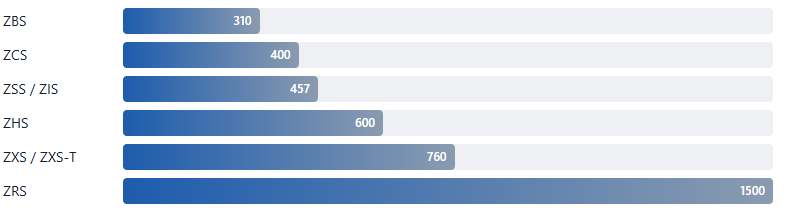
The compact ZBS lump and purge shredder uses a 310 mm rotor for lumps and purgings up to 400 mm in diameter. At the other end, the ZRS pipe and profile shredder uses rotors up to 1,500 mm in diameter to process pipes up to 1,200 mm in diameter.
Variable 2: Rotor speed
Shredders run slowly compared with granulators. Low speed with high torque lets the rotor bite into thick, solid material without throwing it around the chamber, and it limits heat and noise. ZERMA America lists rotor speeds from 23 rpm on the largest ZRS up to 104 rpm on the ZHS horizontal shredder:
| Series | Rotor diameter | Rotor speed | Listed screen size |
|---|---|---|---|
| ZBS lump and purge | 310 mm | 61 rpm | >16 mm |
| ZSS general purpose | 387 to 457 mm | 74 rpm | >40 mm |
| ZIS big volume | 457 mm | 74 rpm | >40 mm |
| ZHS horizontal | 600 mm | 104 rpm | >40 mm |
| ZXS heavy duty | 750 mm | 46 rpm | >60 mm |
| ZXS-T tire | 760 mm | 41 rpm | 80 mm screen bars |
| ZRS pipe and profile | 800 to 1,500 mm | 40 to 23 rpm | See product page |
The pattern is worth noticing: the largest rotors built for the biggest, heaviest material turn the slowest. The ZBS also shows a practical benefit of low speed; ZERMA America notes its low rotor speed and compact design keep noise relatively low.
Variable 3: Knife design and how knives are held
Flat E-type rotor with square knives
Most ZERMA America shredders use a large diameter flat E-type rotor with specially machined pockets that hold and secure the knives. The knives are concave ground and square, and they can be rotated to a fresh cutting edge after one side wears. That means one knife provides several working edges before it is replaced, which lowers wear-part cost and shortens maintenance stops.
Carbide knives for rubber and steel
Tires are a different problem. The ZXS-T tire recycling shredder uses large diameter flat rotors with weld-on hard facing, and its flat knives are made of highly wear-resistant tungsten carbide. With a single stator row it pre-shreds complete car tires or large pieces of truck tires to about 150 mm; with twin stator rows and a screen, it reduces material to sizes above 20 mm.
How shredder rotors differ from granulator rotors
A granulator rotor is built for a final, finer cut at higher speed. The granulator inside the ZERMA America ZCS combination, for example, uses a 3-blade V-cut F-type rotor, while the ZERMA America GSL slow speed granulator uses staggered rotor blades that make individual cuts to increase cutting torque. The shredder rotor’s job is different: take a large, tough piece and turn it into something a granulator can handle.
Variable 4: Rotor width and the feeding system
Rotor width sets how much material can be presented to the knives at once, and it has to work with the infeed. A wide rotor needs a ram or pusher that can spread material across its full width. The ZHS horizontal shredder, for example, pairs rotor widths from 1,400 to 2,520 mm with an angled hydraulic pusher and a large feed hopper. The ZBS takes a different approach: its tangential infeed eliminates the need for a hydraulic pusher, so it can be fed by hand or by conveyor.
Wear protection
Abrasive and filled materials wear rotors as well as knives. ZERMA America offers optional weld-on hard facing for abrasive applications on shredders including the ZXS and ZIS, and the ZIS can be fitted with a wear package for highly abrasive, filled materials.
Matching rotor design to your material
| Material | Rotor features that matter | ZERMA America example |
|---|---|---|
| Purgings and solid lumps | Compact, slow, high-torque rotor; fine screen | ZBS |
| General in-plant plastic scrap, film, bales | Mid-size E-type rotor, ram feeding, screened output | ZSS |
| IBCs, bins, pallets, drums | Large cutting chamber with a ram to hold parts against the rotor | ZIS |
| Large, bulky parts and sheet | Wide rotor with an angled pusher | ZHS |
| Tough, mixed and abrasive inputs | Large, slow rotor with hard facing options | ZXS |
| Large pipe and profile | Very large, very slow rotor with a long feeding trough | ZRS |
| Tires | Hard-faced rotor with tungsten carbide knives | ZXS-T |
Machines mentioned in this article
Find the rotor that fits your material
ZERMA America engineers can match rotor size, speed and knife design to what you actually shred.
Frequently asked questions
What does rotor diameter mean on a shredder?
Rotor diameter is the size of the cutting circle. Larger rotors are generally paired with larger drives and used for larger, tougher material. ZERMA America shredder rotors range from 310 mm on the ZBS to 1,500 mm on the largest ZRS.
Why do industrial shredders run at low speed?
Low speed with high torque lets the rotor cut into thick, solid material without throwing it around, and it limits heat and noise. ZERMA America shredders run from 23 rpm to 104 rpm depending on the model.
What is an E-type rotor?
On ZERMA America shredders, the E-type is a large diameter flat rotor with machined pockets that hold concave ground square knives. The knives can be rotated to a fresh edge after one side wears.
Is a shredder rotor the same as a granulator rotor?
No. A shredder rotor turns slowly to break down large, tough pieces. A granulator rotor makes a finer final cut, typically at a higher speed and with different knife geometry.
Which rotor is best for abrasive materials?
Look for hard facing and wear packages. ZERMA America offers optional weld-on hard facing on shredders such as the ZXS and ZIS, and a wear package for highly abrasive, filled materials on the ZIS.