Most molders don’t think of themselves as recyclers. But every shot from a cold-runner tool produces plastic you paid for and can’t sell, and every startup produces a few parts nobody wants. That material either goes back into production or goes into a dumpster. Both choices cost money. Only one gets any of it back.
This guide walks through the main ways to handle molding scrap, from a small granulator tucked beside the press to a central system serving the whole plant, and how to tell which one fits your floor. ZERMA America will be at AMI Plastics World Expos North America in Cleveland on November 11 and 12, so if you’d rather talk it through in person, the booth details are below.
Meet ZERMA America at AMI Plastics World Expos North America
November 11 to 12, 2026, 9am to 5pm | Huntington Convention Center of Cleveland, 300 Lakeside Avenue, Cleveland, OH 44113
Booth E4803, Exhibit Halls A to C, shared with our sister company Virtus Equipment
What Molding Scrap Really Costs
The volume adds up faster than most people expect. An older U.S. patent describing in-press regrind systems put sprues, runners and scrap at 8% to 25% of total material in molding operations. The exact figure depends on your tools, and hot runners can cut it sharply, but on a cold-runner job a meaningful share of every pound of resin never becomes a part.
Throwing it out isn’t free either. The Environmental Research & Education Foundation (EREF) reports the national average landfill tipping fee rose 10% in 2024 to $62.28 per ton, the largest jump since 2022. That’s before hauling, and before the cost of replacing the resin you just paid to bury.
of material can end up as sprues, runners and scrap
average U.S. landfill tipping fee in 2024
one-year jump in tipping fees, the largest since 2022
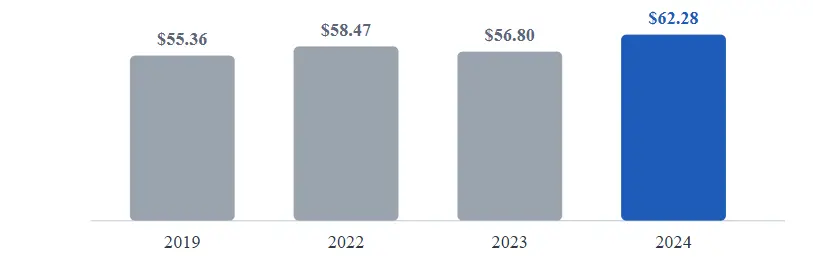
Source: Environmental Research & Education Foundation (EREF), MSW landfill tipping fee analyses, 2019 to 2024
Disposal keeps getting more expensive. Reclaiming scrap in-house avoids both the tipping fee and the cost of replacement resin.
What Makes Regrind Usable
Regrind only saves money if it runs. Plastics Technology lists the usual reasons blended regrind causes trouble at the press: degraded polymer, a broad range of granule sizes that a screw can’t melt evenly, contamination from other materials, and excessive fines.
Your granulator has a direct hand in at least three of those. It controls particle size and how many fines get made, it adds heat (which can degrade the polymer), and where it sits on your floor decides how much chance material has to get mixed up or contaminated on the way back to the hopper. We’ve written about each of these in more depth:
- Screen Size Explained: How One Number Controls Throughput, Fines, and Regrind Quality
- Heat Is the Enemy of Good Regrind
- Contamination Is the Silent Tax on Your Regrind
Four Ways to Handle Molding Scrap
Option 1: Granulate beside the press
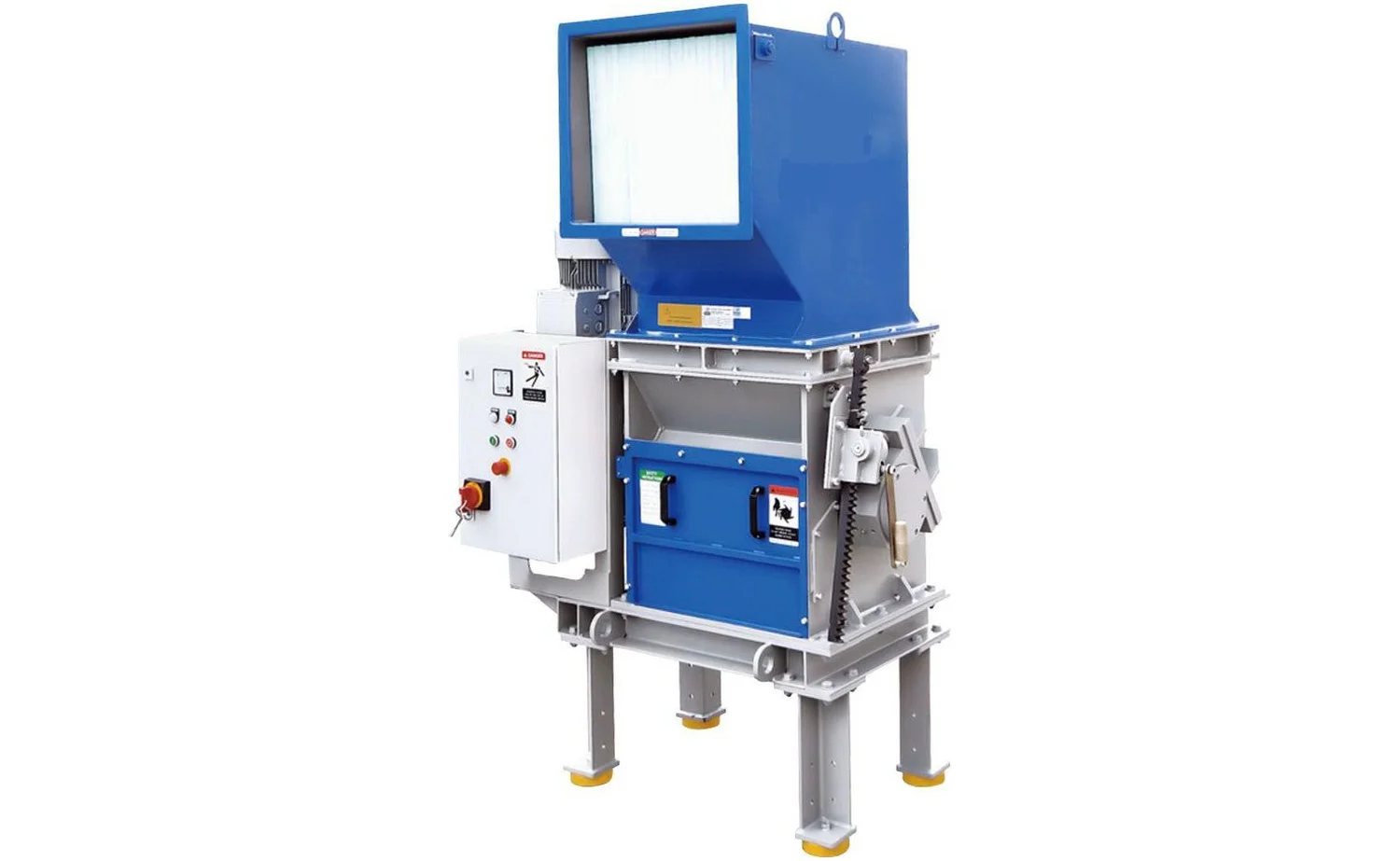
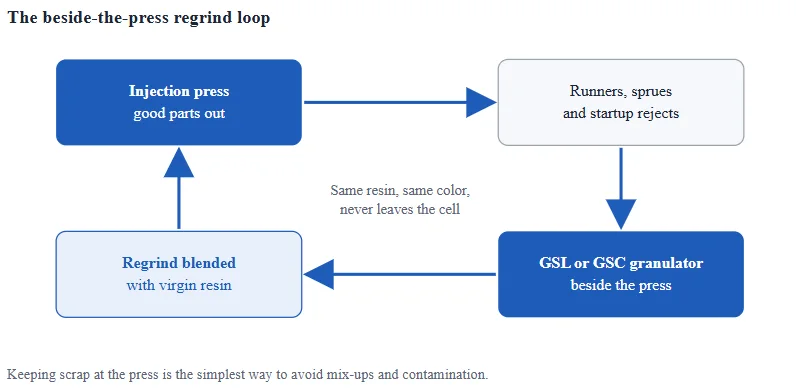
For runners and sprues, the shortest path is usually the best one. A granulator placed right next to the press takes runners as they drop or as a robot places them, grinds them immediately, and sends regrind straight back to the feed throat. Material never leaves the cell, so it can’t get mixed with another resin or color, and nobody has to collect bins at the end of a shift.
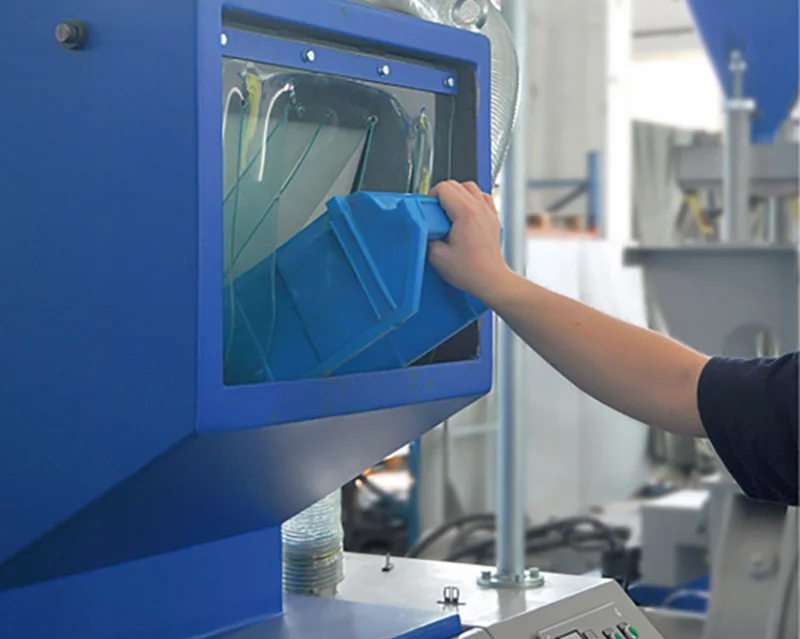
Option 2: Handle bulkier parts at the press
Option 3: Send it to a central granulator
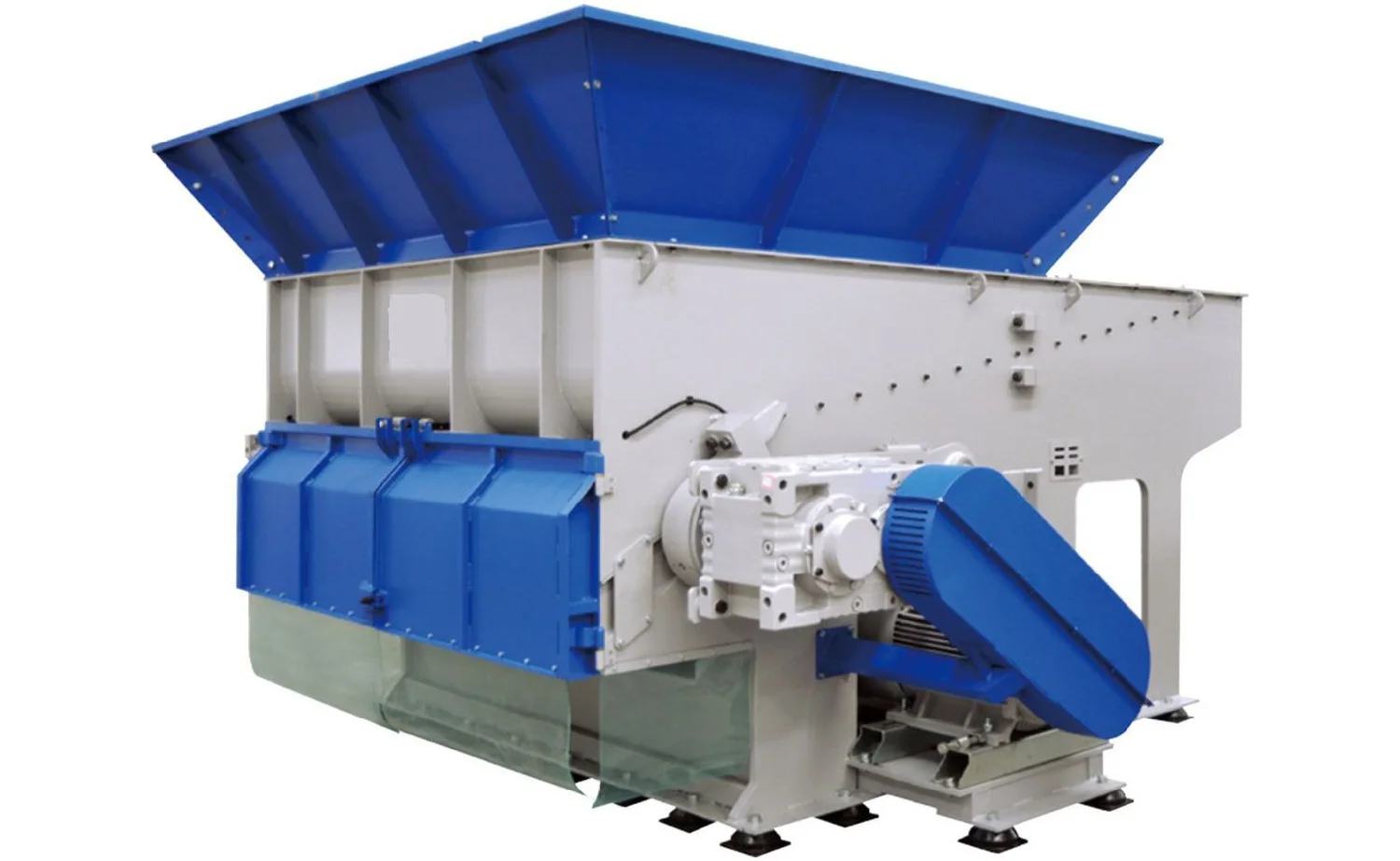
When a plant runs many presses, collects rejects from several cells, or molds thick-walled parts, a central granulator often makes more sense than a machine at every press. Scrap gets collected, ideally kept sorted by resin and color, and processed in one place at higher throughput.
Option 4: Shred first, then granulate
Large rejects, thick sections and purge lumps can overwhelm a granulator. In those cases, a shredder breaks the material down first and a granulator finishes it.
Side-by-Side Comparison
| Approach | Best for | ZERMA America machines | Watch for |
|---|---|---|---|
| Beside the press | Runners and sprues, single resin per cell | GSL, GSC | Matching hopper and frame to the press or robot |
| Bulky parts at the press | Hollow and bulky parts, blow molding scrap | GST | Part size versus hopper opening |
| Central granulation | Many presses, collected rejects, thick-walled parts | GSE, GSH | Keeping scrap sorted by resin and color |
| Shred, then granulate | Large rejects, thick sections, lumps | ZCS, ZSS + granulator | Sizing the shredder and granulator to each other |
Questions to Answer Before You Choose
- What resins and colors do you run, and how often do they change?
- Are you running hot runners, cold runners, or both?
- What’s the largest reject part you need to process?
- How many pounds of scrap per hour, per press or plant-wide?
- Will regrind go straight back to the same press, or into other jobs?
- How much floor space and noise allowance do you have near the press?
Bring those answers to Booth E4803, or send them ahead with our Recycling Application Worksheet. We can also test your actual scrap before you decide.
Frequently Asked Questions
What is a beside the press granulator?
A compact granulator placed next to an injection molding machine that grinds runners, sprues and rejects as they come off the press, so regrind can go straight back into production.
Should I use a beside the press granulator or a central granulator?
Beside the press usually works best for runners and sprues from a single resin per cell. A central granulator makes more sense when you collect scrap from many presses, process thick-walled parts, or need higher throughput.
Why does regrind particle size matter?
An injection molding screw has trouble melting a wide range of particle sizes evenly, and excessive fines cause their own problems. Consistent regrind runs more predictably when blended with virgin resin.
When do I need a shredder for molding scrap?
When parts are too large or thick, or when you’re dealing with dense purge lumps. A shredder breaks the material down first so a granulator can finish it.
Where can I see ZERMA America at AMI Plastics World Expos 2026?
At Booth E4803, Exhibit Halls A to C, Huntington Convention Center of Cleveland, November 11 to 12, 2026.
Talk molding scrap with us in Cleveland
ZERMA America and Virtus Equipment, Booth E4803, AMI Plastics World Expos North America, November 11 to 12, 2026.