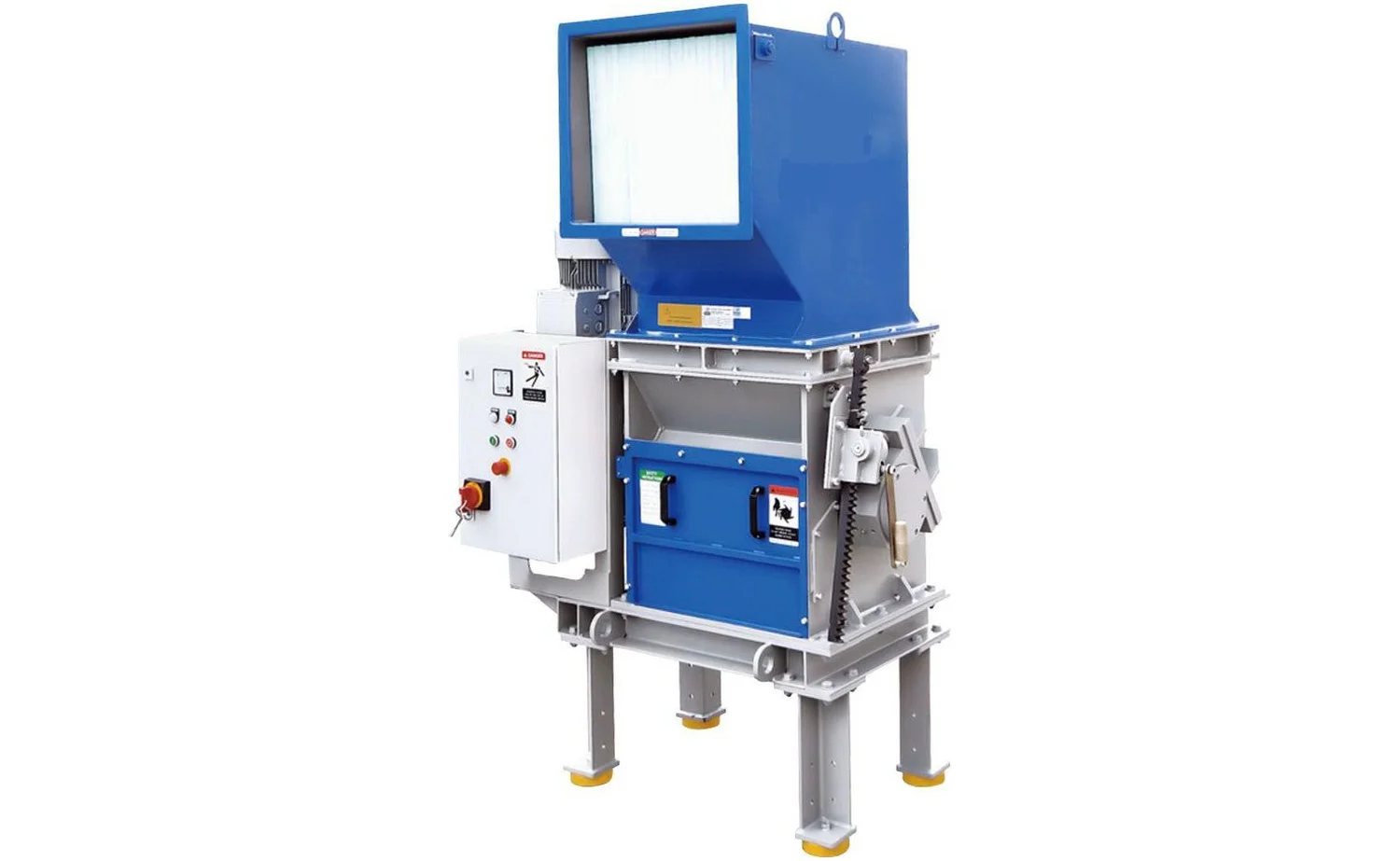
Walk through almost any compounding or extrusion plant and you’ll find it: a gaylord, a corner, sometimes a whole bay full of hardened purge. Hockey-puck lumps from startups. Multicolored blobs from grade changes. Head waste from a die swap. Nobody planned for it, and nobody quite knows what to do with it.
Here’s the thing about that pile. It’s made of resin you bought, melted and paid to run through a machine. Treating it as trash means paying for it twice. This post is for the production managers and plant engineers who don’t think of themselves as recyclers, but who would very much like that pile to go away.
ZERMA America will be at AMI Plastics World Expos North America in Cleveland, where Compounding World Expo and Plastics Extrusion World Expo share the floor. If purge is a headache in your plant, it’s a good place to find us.
Meet ZERMA America at AMI Plastics World Expos North America
November 11 to 12, 2026, 9am to 5pm | Huntington Convention Center of Cleveland, 300 Lakeside Avenue, Cleveland, OH 44113
Booth E4803, Exhibit Halls A to C, shared with our sister company Virtus Equipment
Why Purge Piles Up
Purging is how extruders and compounders clean out a barrel between runs. It happens at startup, at every color change, at every grade change, and whenever contamination or carbon builds up during a long run. Compounders who run many grades and colors purge constantly, because the next batch can’t carry anything over from the last one.
Plastics Technology makes a point that’s easy to forget: purge piles cost just as much to make as contaminated parts and should be counted in the total scrap rate. In other words, that lump isn’t “extra.” It’s production capacity that turned into scrap.
What a Purge Actually Costs
Plastics Technology walked through one profile extruder’s real numbers. A changeover took two hours on a machine that runs at $100 per hour, so downtime cost $200. The plant used 25 pounds of virgin HDPE as purge at 75 cents a pound, adding $18.75. Total cost of one changeover: $218.75.

Source: Plastics Technology, “Follow These Tips to Power Up Your Purging Process”
Downtime drives most of the cost. But every changeover also leaves material behind, and that pile is the part you can still recover.
Plenty of plants work hard on shrinking changeover time, and they should. But no matter how lean the purge gets, some material still comes out the other end. Multiply that by every changeover, on every line, every week, and the pile grows. Then it costs money again when it leaves. EREF reports the average U.S. landfill tipping fee hit $62.28 per ton in 2024, up 10% in a single year.
cost of one two-hour changeover in a profile extrusion example
purge piles cost as much to make as contaminated parts
average U.S. landfill tipping fee in 2024, up 10%
Why Lumps Are Hard on Granulators
If purge is just plastic, why not toss it in the granulator you already own? Because a granulator is built to cut pieces it can grab: runners, thin-walled parts, shredded flake. A purge lump is the opposite. It’s solid, dense and irregular. It bounces around the cutting chamber, loads up the motor, wears knives faster and generates a lot of heat.
That heat is a quality problem, not just a maintenance one. Our post Heat Is the Enemy of Good Regrind explains how it softens flake and degrades polymer. And if you’re wondering why knife life varies so much from one application to another, Blade Steel and Rotor Geometry covers it.
The fix is to put a machine in front of the granulator that’s built for lumps.
Shredding Purge In-House
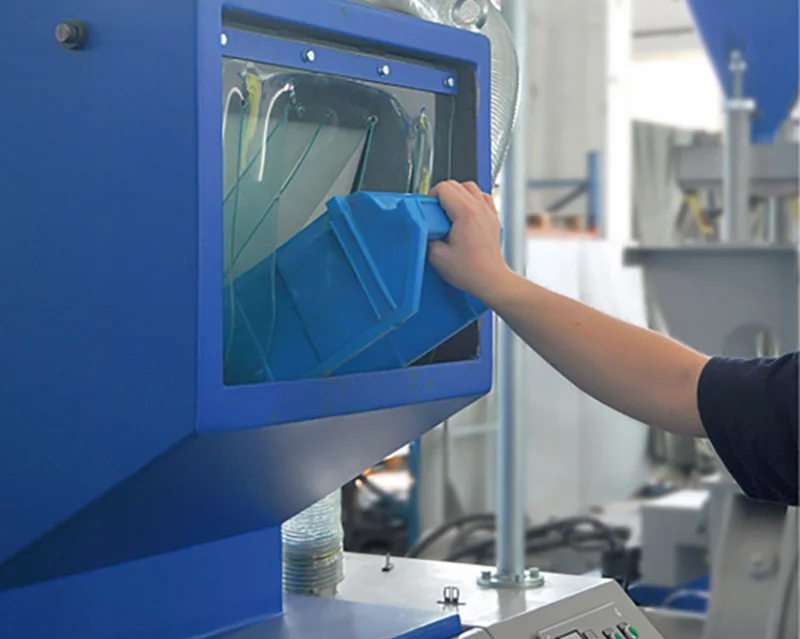
For everyday lumps and purgings: the ZBS
It’s also useful for small batches of low-volume products that you want to keep separate from the main line. If your lumps are on the small side, a ZBS can work as an add-on in front of the granulator you already own.
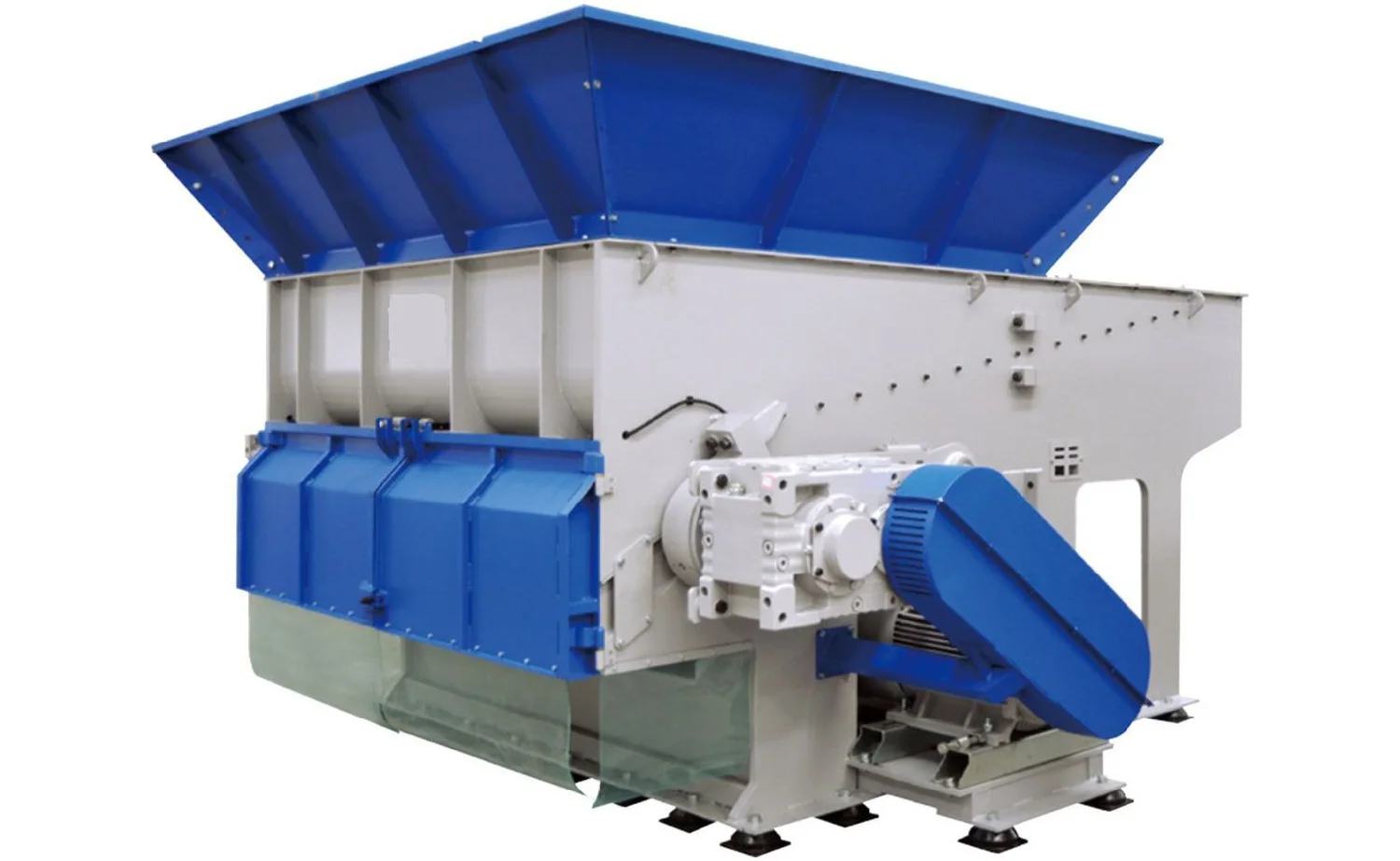
For large extruder and compounding purgings: the ZXS
Then granulate
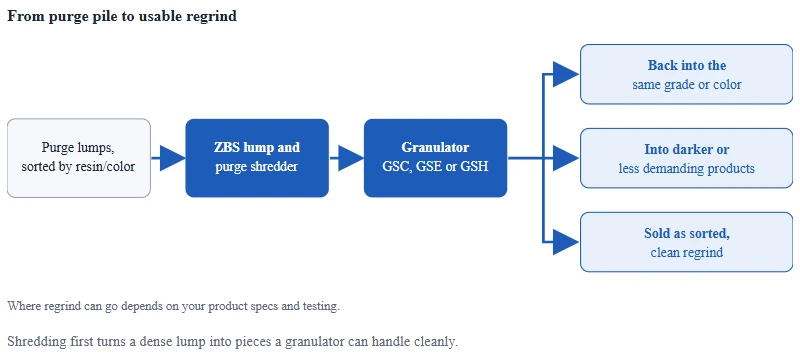
Shredded purge goes on to a granulator for final sizing. Depending on volume, that could be a compact GSC, an economical GSE, or a heavy-duty central GSH acting as a second-step granulator after the shredder. If floor space is tight, the ZCS Shredder Granulator Combination puts both steps in one unit.
| Your purge situation | Typical starting point |
|---|---|
| Small to medium lumps from startups and color changes | ZBS feeding an existing or new granulator |
| Large purgings from big extruders or compounding lines | ZXS + central GSH |
| Mixed purge plus bulky rejects, limited floor space | ZCS shredder granulator combination |
| Risk of tramp metal in the purge | Add metal separation and conveying |
Keeping Purge Regrind Worth Something
Shredding solves the size problem. Sorting solves the value problem. A pile of mixed resins and colors has limited uses. The same material separated by polymer and color is a lot easier to put back to work. A few habits make a big difference:
- Separate at the machine. Keep a labeled bin for each resin family at each line instead of one shared purge bin.
- Keep commercial purging compound separate from resin purge whenever possible, since it isn’t the same material as your product.
- Let hot lumps cool before shredding.
- Watch for tramp metal. Screen pack pieces and tools find their way into purge piles more often than anyone admits.
- Test before you blend. Run a small trial before putting purge regrind back into a demanding grade.
For a deeper look, read Contamination Is the Silent Tax on Your Regrind and What Makes Regrind Valuable.
Frequently Asked Questions
Can purge lumps be recycled?
Yes. Purge is the same resin you run in production. Once it’s shredded, granulated and kept sorted by polymer and color, it can often go back into production or into less demanding products, depending on your specs and testing.
Why can’t I put purge lumps straight into my granulator?
Purge lumps are dense, solid and irregular. They bounce in the cutting chamber, load the motor, wear knives and create heat. A shredder designed for lumps breaks them down first so the granulator can work normally.
What is a lump and purge shredder?
A compact shredder built specifically for the lumps and purgings created during startups and changeovers. The ZERMA America ZBS uses a tangential infeed, so it doesn’t need a hydraulic feeding system.
Should purge be counted as scrap?
Yes. Plastics Technology notes that purge piles cost just as much to make as contaminated parts and should be included in the total scrap rate.
Where can I see ZERMA America at AMI Plastics World Expos 2026?
At Booth E4803, Exhibit Halls A to C, Huntington Convention Center of Cleveland, November 11 to 12, 2026.
Turn your purge pile into a plan
ZERMA America and Virtus Equipment, Booth E4803, AMI Plastics World Expos North America, November 11 to 12, 2026.