Every extrusion line makes scrap. Startup lengths come off before the line settles. A die change leaves a run that misses tolerance. A coil gets kinked out in the yard. None of that means the plant is badly run. It’s simply what running a plant costs.
What separates one extruder from another is what happens to that scrap next. Some plants saw it into pieces by hand, stack it in a corner and sell it for whatever a broker offers. Others have it back in production by the next shift. Most of the time, the difference comes down to one question: can your size reduction equipment take the scrap in the shape it’s already in?
ZERMA America will be in Cleveland on November 11 and 12 for AMI Plastics World Expos North America, and pipe and profile extruders are one of the groups we most want to meet. This is the conversation we’d have with you at the booth.
Meet ZERMA America at AMI Plastics World Expos North America
November 11 to 12, 2026, 9am to 5pm | Huntington Convention Center of Cleveland, 300 Lakeside Avenue, Cleveland, OH 44113
Booth E4803, Exhibit Halls A to C, shared with our sister company Virtus Equipment
Why Pipe and Profile Scrap Is Worth Recovering
Recovered extrusion scrap is not a niche idea. It already makes up most of the recycled vinyl in North America. According to the Vinyl Institute’s latest study, the U.S. and Canada recycled more than 1.127 billion pounds of PVC in 2024. Post-industrial material, which is mostly scrap generated during manufacturing, rose 10% to 1.056 billion pounds. The study credits high landfill costs and strong manufacturer demand for recycled content for part of that growth.
PVC recycled in the U.S. and Canada in 2024
of that total came from post-industrial sources
of post-consumer HDPE becomes plastic pipe every year
pipe diameter the ZRS shreds without pre-cutting
PVC recycled in the U.S. and Canada, 2024 (million lb)

Source: The Vinyl Institute, The State of PVC Recycling in the USA & Canada (2026)
Nearly all of the PVC recycled in North America is scrap that never left a manufacturing environment.
Polyethylene pipe tells a similar story from the other direction. According to the Plastics Pipe Institute, more than 600 million pounds of post-consumer HDPE becomes plastic pipe every year, and standards such as ASTM F2306 and AASHTO M294 allow corrugated HDPE drainage pipe to be made with recycled polyethylene. Recycled pipe material has buyers and a standards path. The scrap you make in-house is the cleanest feedstock you’ll ever get, because you already know exactly what’s in it.
The Real Problem Is Geometry, Not Polymer
Ask most extruders why pipe scrap piles up and they won’t blame the material. They’ll describe its shape.
- Length. A 20-foot stick won’t fit a granulator throat, so someone has to cut it first.
- Diameter and wall thickness. Large, thick-walled pipe needs torque that a standard granulator was never built to deliver.
- Mixed sizes. A plant running several product lines ends up with a pile of different diameters and walls, all on the same day.
- Profiles. Window, fence and conduit profiles have hollow chambers, ribs and a mix of thick and thin sections. They flex, bridge in hoppers and tangle.
The usual fix is a saw, and that’s where the hidden cost lives. Manual cutting takes labor away from the line, adds a safety exposure most plant managers would rather not have, and turns a scrap problem into a scheduling problem. The better approach is equipment that takes the scrap whole.
A Three-Step Pipe Recycling System
ZERMA America builds pipe recycling around a simple sequence: shred the bulk, granulate to a consistent size, and pulverize only when a powder is actually needed. ZERMA America is one of the few suppliers that makes every one of those machines, plus the conveyors, separators and metal detection that connect them.
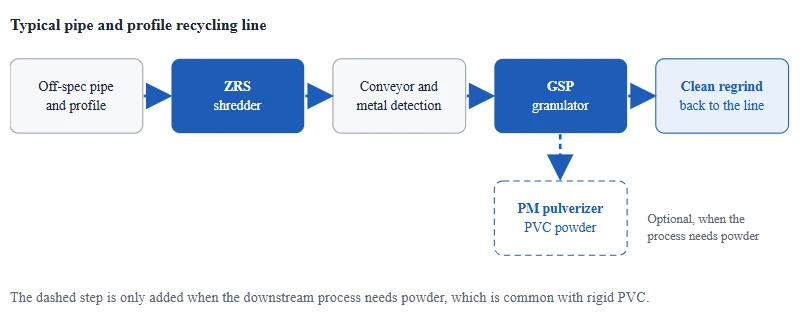
Step 1: Shred it whole with the ZRS Pipe Profile Shredder
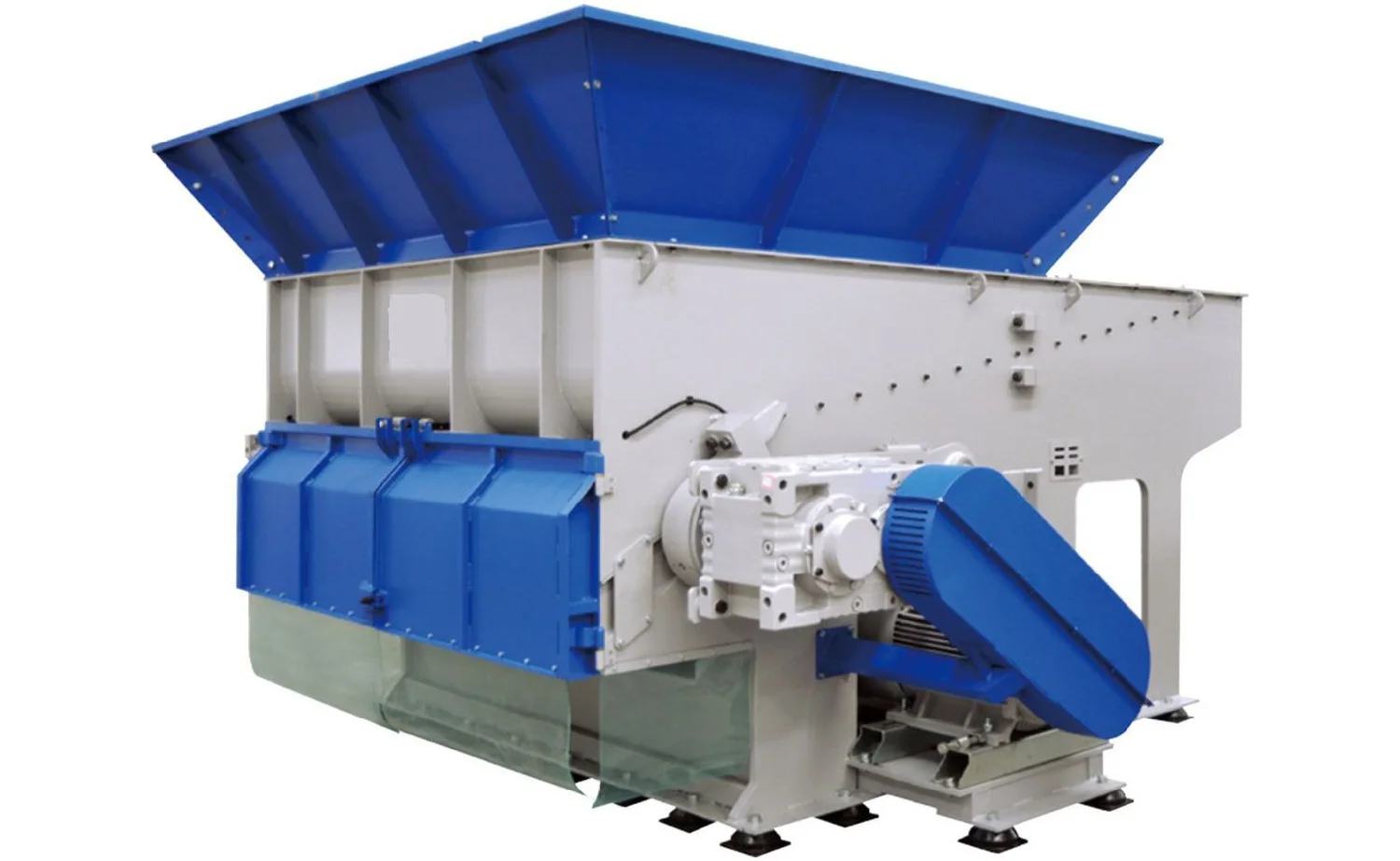
ZERMA America describes the ZRS Pipe Profile Shredder as the world’s first single-shaft shredder able to handle large diameter pipe up to 1200 mm without pre-cutting. It’s built mainly for large diameter pipe or bundles of smaller pipe and profile made of HDPE, PP and PVC, with a standard hopper that takes lengths up to 6 meters, using a low-speed, high-torque rotor and a hydraulic feeder that pushes material into the cutting zone. It also takes mixed diameters with a wide range of wall thicknesses.
For the plant floor, that means no saw station and no one hand-feeding cut pieces. Load the trough, close it, and the machine does the rest. Profile lines benefit too, because bundles of conduit or profile can go in together instead of one piece at a time.
Step 2: Granulate to consistent regrind with the GSP
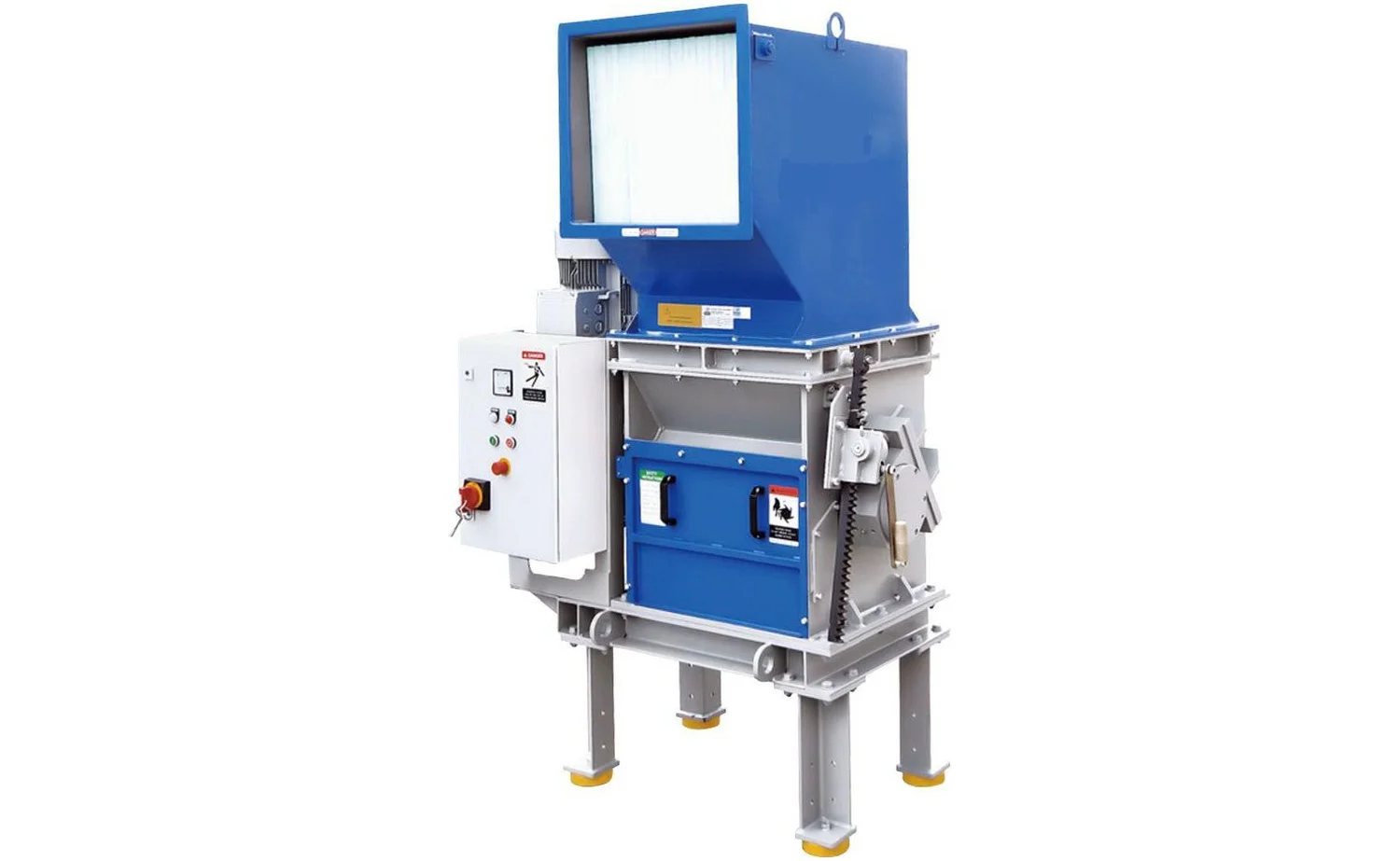
Shredded pipe still isn’t regrind. The GSP Pipe and Profile Granulator takes the shredded pieces down to a uniform particle size. It’s available with rotor widths up to 1400 mm and rotor diameters from 560 to 700 mm, sized for the volumes pipe plants deal with.
Depending on diameter and wall thickness, smaller pipe and profile can sometimes go straight into a granulator without shredding first. A material test settles that question quickly. The screen in the granulator sets the final particle size, and getting it right matters more than most people expect. Our post Screen Size Explained covers how that one number drives throughput, fines and regrind quality.
Step 3 (when needed): Pulverize PVC with the PM
Rigid PVC is commonly processed from powder dry blends, so many PVC pipe and profile producers want reclaimed material as a powder that mixes evenly with their blend. The PM Plastics Pulverizer is a high-speed disc pulverizer, available with disc diameters from 300 to 800 mm, that turns regrind into fine powder.
Matching the Setup to Your Scrap
There’s no single pipe recycling line that fits every plant. Here’s how we’d typically start the conversation:
| Your scrap | Typical starting point | Why |
|---|---|---|
| Large-diameter or long pipe (HDPE, PP, PVC) | ZRS + GSP | Shreds whole lengths, then granulates to consistent regrind |
| Small pipe, tubing, conduit or profile | ZRS bundle feeding, or GSP direct | A material test shows whether shredding is needed first |
| Rigid PVC that must return as powder | Add a PM pulverizer | Powder blends evenly with PVC dry blend |
| Startup lumps and purgings from the extruder | ZBS Lump and Purge Shredder | Dense lumps need a shredder made for them |
| Risk of metal in the scrap stream | Conveyors with metal detection | Protects knives and keeps regrind clean |
Contamination deserves its own mention. One stray fitting can damage knives and ruin a batch of regrind. Our post Contamination Is the Silent Tax on Your Regrind covers how to keep it out.
What to Bring to Booth E4803
The fastest way to get a real recommendation at the show is to walk up with a few numbers. If you can, bring:
- Polymer types you run (HDPE, PP, PVC or others)
- Largest outside diameter and wall thickness you need to process
- Longest lengths that end up as scrap
- Volume, in pounds per hour or per week
- Where the regrind goes: back into your line, sold, or turned into powder
- Floor space available and any noise limits
- Photos or samples of the scrap itself
Can’t make it to Cleveland? Fill out our Recycling Application Worksheet or send samples for material testing, and our team will run your actual scrap before you commit to anything.
Frequently Asked Questions
Do I need to cut pipe before shredding it?
Not with the ZRS. ZERMA America describes it as able to handle large diameter pipe up to 1200 mm without pre-cutting, so long lengths can be loaded whole.
What’s the difference between a pipe shredder and a pipe granulator?
A shredder breaks long or bulky pipe into manageable pieces using high torque at low speed. A granulator then cuts those pieces into uniform regrind sized by its screen. Many pipe plants use both, in that order.
Can recycled pipe scrap go back into new pipe?
Often, yes, depending on the product and its standards. For example, ASTM F2306 and AASHTO M294 allow corrugated HDPE drainage pipe to be made with recycled polyethylene. Your own clean, sorted scrap is usually the easiest material to reuse.
When do I need a pulverizer?
When your process needs powder instead of regrind. This is common with rigid PVC pipe and profile, which are typically made from powder dry blends.
Where can I see ZERMA America at AMI Plastics World Expos 2026?
At Booth E4803, Exhibit Halls A to C, Huntington Convention Center of Cleveland, November 11 to 12, 2026.
Bring your scrap questions to Cleveland
ZERMA America and Virtus Equipment, Booth E4803, AMI Plastics World Expos North America, November 11 to 12, 2026.